Showing posts with label phishing. Show all posts

Tuesday, August 11, 2026

, , ,

Enriched URL Reports: VirusTotal URL Scanning 2.0

Introduction

In today's fast-moving cybersecurity landscape, threat analysts must move beyond basic, binary reputation scores to successfully defend against modern, highly adaptive web threats. Traditional URL analysis has been redefined by the launch of URL Scanning 2.0, an update that significantly expands VirusTotal's URL analysis capabilities by introducing automated visits with a full browser instance and deeper historical visibility.

Instead of relying on static reputation scores alone, URL Scanning 2.0 enriches reports with "under-the-hood" headless browser telemetry, including the DOM, full-page screenshots, web technologies, and network request logs. Crucially, it introduces historical analysis pivoting, giving analysts the ability to track how a page has changed over time.

URL Scanning 2.0

To successfully defend against modern, highly adaptive web threats, threat analysts must move beyond basic, binary reputation scores. With the debut of URL Scanning 2.0, VirusTotal introduces robust headless browser integration that captures how a page behaves dynamically in a clean sandbox environment.

Every scan now generates rich, granular telemetry that provides a blueprint of the target page's execution:

- Headless Browser Data: Full-page visual screenshots, full DOM (Document Object Model) trees, and web technologies (e.g., Cloudflare, PHP, HTTP/3).

- Page and Network Statistics: Highly detailed counters of individual network requests, encrypted HTTPS transactions, unique contacted domains/subdomains, and serving IP address mappings with geographic tracking.

- Anti-Phishing Fingerprints: Automatic identification of brands, cloned-website tags, password input fields, tracker IDs, and favicon dhashes.

- Historical Pivoting: A timeline containing historical analyses of a URL with its corresponding risk score, allowing analysts to track exactly how its metadata and content have shifted over time.

Access Levels in VirusTotal

Public Access (Free for VirusTotal Users)
The core enhancements of the URL Scanning 2.0 engine are available to everyone. For the latest scan, analysts can access rich telemetry generated by headless browser execution, including visual screenshots, extracted JavaScript globals, console messages, and a list of all loaded network resources.

VirusTotal Premium Customers
For paid VirusTotal customers, the platform unlocks deeper retrospective capabilities and exclusive data fields. Analysts have the ability to pivot to and review the full historical analyses of a URL as it was observed at specific points in time, and access advanced telemetry like the full DOM captures of the execution. Furthermore, premium access unlocks advanced infrastructure relationships, allowing users to pivot on contacted domains, IPs, and downloaded files.

Note: The aforementioned Google Threat Intelligence and Automatic Brand Identification features are exclusively available to Google Threat Intelligence customers.

Investigating a Phishing Case

Initially, when an analyst navigates to the mentioned URL to view the report generated by VirusTotal, they would see something similar to the following with the new URL Scanning features:

At the top of the interface, we can see that the URL has been scanned three times. This means there are three distinct reports for the same URL, each potentially containing different information that could be highly useful for an analyst. In the top right corner, we can view these past analyses by clicking on "History".

This is where the new historical analysis pivoting comes into play: it allows analysts to travel back through a URL's timeline with point-in-time snapshots.

By clicking on "History", we can view all the historical analyses for that URL, including response codes, detections, screenshots, and other metadata. You can also apply filters to narrow down the timeline and view only the historical records you are interested in, based on specific response codes, URL actions, and other criteria.

In this case, if we click on the initial historical analysis performed on July 6, 2026 (as shown in the screenshot above), we can examine its specific information across the "Summary", "Details", and "Detection" tabs. A key feature of URL Scanning 2.0 is that the information within these report tabs will dynamically re-render to match the exact historical state of the snapshot you select.

As observed in the history timeline, after clicking on this specific analysis included a live screenshot and other relevant metadata, indicating the scan occurred while the website was fully operational and actively distributed. The previous screenshot gives us a clear view of how the phishing page was visually structured.

Furthermore, diving into the "Details" tab reveals other interesting technical artifacts from the campaign. These details are incredibly useful for pivoting and identifying new malicious URLs that share similar characteristics.

Among the wealth of information generated by URL Scanning 2.0, analysts will find HTTP transactions, detected JavaScript variables, console messages, external outbound links, and other critical metadata. These key technical markers serve as pivotable and searchable attributes, allowing teams to conduct advanced footprint hunting and instantly find other malicious URLs exhibiting the exact same technical fingerprint.

Furthermore, every snapshot taken during each analysis provides the complete Document Object Model (DOM) tree captured by the full browser instances. It allows you to inspect the exact structure of the page as it was dynamically rendered to the victim, exposing elements that static scans might miss. As can be seen in the following image, having direct access to this point-in-time DOM data empowers analysts to dig deep into the page's architecture.

Advanced Threat Hunting: Scaling the Investigation

Let's scale our investigation using VirusTotal Intelligence queries based on the artifacts discovered via URL Scanning 2.0.

During the analysis of the financial phishing site, we discovered that the page relied on static assets hosted on a third-party domain: jiaoyisuo.thai2570[.]com. We can pivot on this finding using an advanced query:

VT Query
entity:url (outgoing_link:jiaoyisuo.thai2570.com OR content:jiaoyisuo.thai2570.com)

The results demonstrate a multi-brand operation, including fake cryptocurrency exchange portals and typosquatting domains for other financial services. By further pivoting on the hosting domain with entity:domain "thai2570.com", analysts can map out a highly segmented subdomain tree used for hosting assets, capturing payments, and backend control panels.

Conclusion

URL Scanning 2.0 represents a paradigm shift in how security analysts investigate web-based threats. Investigations are no longer limited to static verdicts. By surfacing powerful metadata directly inside the workflow—such as historical DOM captures, live screenshots, and pivotable technical identifiers—analysts can now turn a single indicator into a comprehensive infrastructure map.

Log in to VirusTotal to explore the new URL Scanning 2.0 features today, and consider upgrading to VirusTotal Premium to unlock the full power of historical pivoting and advanced threat hunting.

Wednesday, February 26, 2020

, , , , , , , , ,

Uncovering threat infrastructure via URL, domain and IP address advanced pivots a.k.a. Netloc Intelligence


Quick links:
https://support.virustotal.com/hc/en-us/articles/360001387057
https://developers.virustotal.com/v3.0/reference#intelligence-search
https://github.com/VirusTotal/vt-py

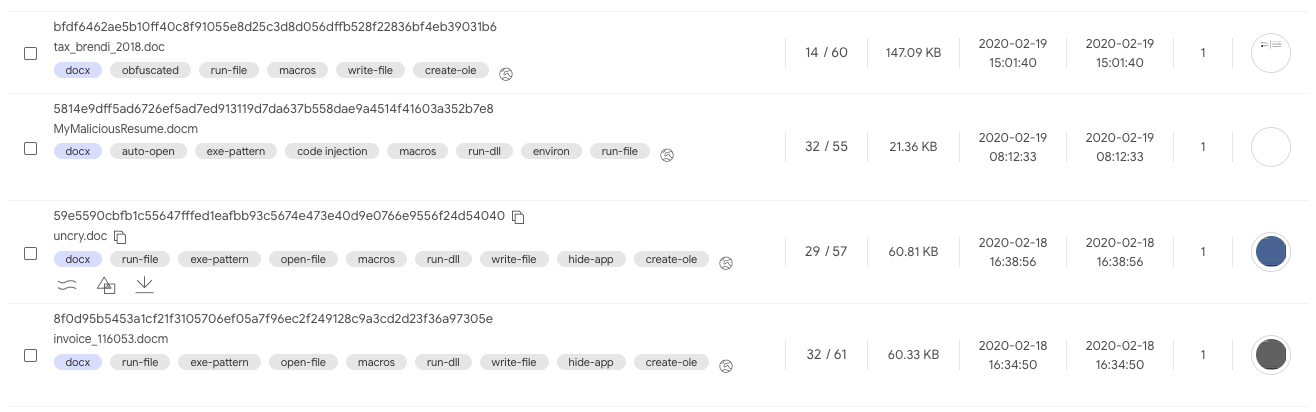
Ten years ago, VirusTotal launched VT Intelligence; a critical component of VT Enterprise which offers users the capability to search over VirusTotal's dataset using advanced search modifiers. VT Intelligence allows security professionals to pinpoint malware based on its structural, behavioural, binary, metadata, etc. properties to uncover entire threat campaigns.

For example, the following search query instructs VirusTotal to search for all documents that make use of macros whose static analysis seems to reveal some kind of payload execution and that when executed in a dynamic analysis environment (sandbox) reach out to a URL (highly suspicious sequence of events):
type:docx tag:macros tag:run-file behaviour_network:http


By drilling down within the VT corpus and identifying these kinds of suspicious patterns, analysts can discover new threats and build the defenses for them.

However, this approach has certain limitations. In the context of an attack, hashes/files are one of the last observables, to mitigate a threat, often analysts must begin by studying the campaign at the network level. A single domain/URL/IP address might be used to distribute thousands of server-side polymorphic variants of the same malware family. Similarly, very often it is far easier to discover new threat campaigns by focusing on the network side of things, has an adversary set up a new domain to distribute his malware? Can I block such domain in my network perimeter defenses (IDS, firewalls, webproxy etc.) even before he leverages it to distribute malware? VT Graph allows you to understand this easily:


As you can see, by blocking the domain bbvaticanskeys[.]com we would be, all of a sudden, killing the chances of our organization’s users downloading any malware that it delivers now or in the future and we would also be preventing the exfiltration of data to the domain if the compromise had already taken place. Note that hundreds of different variants communicate with the domain. In an onion layered security model it is important to build defenses not only against the bullets, but also against the gun, the bad actor porting the gun and the organization to which they belong.


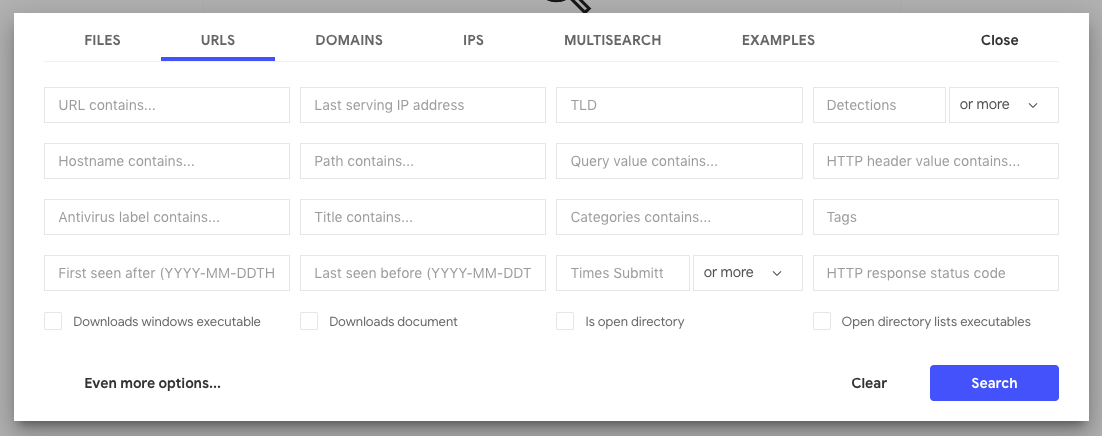
Enter VT Intelligence’s netloc faceted search layer. We are supercharging the investigation capability of VT Enterprise customers by allowing a myriad of search modifiers over the domains, IPs and URLs that VirusTotal scans and sees in its backend processes, at no extra cost. This new functionality has been seamlessly rolled out to your accounts and it will simply consume search quota in the same manner that traditional VT Intelligence and VT API queries do.

So what exactly does this mean for investigators? VirusTotal can now power numerous new use cases:

Discover new threat campaign infrastructure set up via builders/kits and perform early blocking at the network perimeter level


Often adversaries instrument their attacks via trojan builders, exploit kits, command-and-control panels, etc. It is basically tooling that allows less technical crooks to set up an attack or that accelerates the time to launch a campaign.

The catch is that these kits often lead to repeated patterns that can be used to identify an attack:
  • Common URL path subsequences.
  • Uncommon HTTP ports.
  • Distinctive server HTTP response headers.
  • Repeated URL GET/POST parameters across campaigns.
  • etc.
Repetition of server setup patterns is something you can easily observe by browsing over something like URLhaus:


With the netloc intelligence module you can now launch searches like:

entity:url query_field:worker query_value:universal - Silentbruter malware
entity:url path:"fre.php" - LokiBot CnC
entity:url port:7000 path:gw
entity:url path:"/zehir/z3hir"
entity:url path:"bstr.php"
entity:url path:"tuk_tuk.php"
entity:url path:"/private/checkPanel.php"

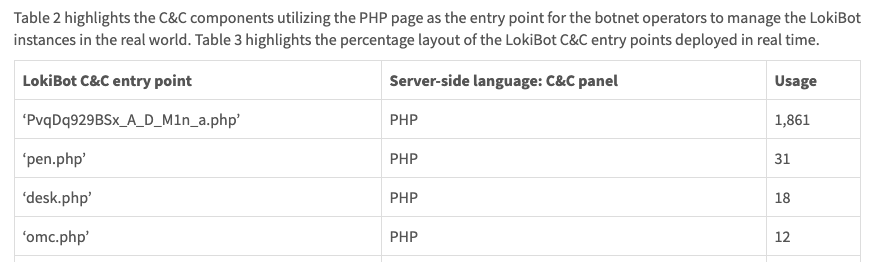
With regards to path commonalities, Virus Bulletin recently published an article on dissecting the C&C panel deployments, it clearly portrays how new malware variants and threat infrastructure can be identified by focusing on CnC kit patterns:


The author’s observations are easily backed with the following VT Intelligence search:
entity:url path:"PvqDq929BSx_A_D_M1n_a.php"

By focusing on the newest sightings first, you can immediately discover new infrastructure being set up by attackers. You can block the pertinent domains/IPs long before they may impact your organization and very often long before blocking technologies catch up on the malware that they deliver.

Track threat actors by revealing new threat infrastructure operated by the same group


Sometimes the patterns do not surface in the URL itself but rather in the domain registration details, SSL certificates, DNS TXT records, etc. It is not uncommon to see attackers registering new domains with the same email address or identical fake physical address. The new netloc intelligence component allows you to pivot over (anonymized - privacy preserving) whois details.

Let’s look at an interesting reported campaign:

New Advanced Phishing Kits Target Digital Platforms
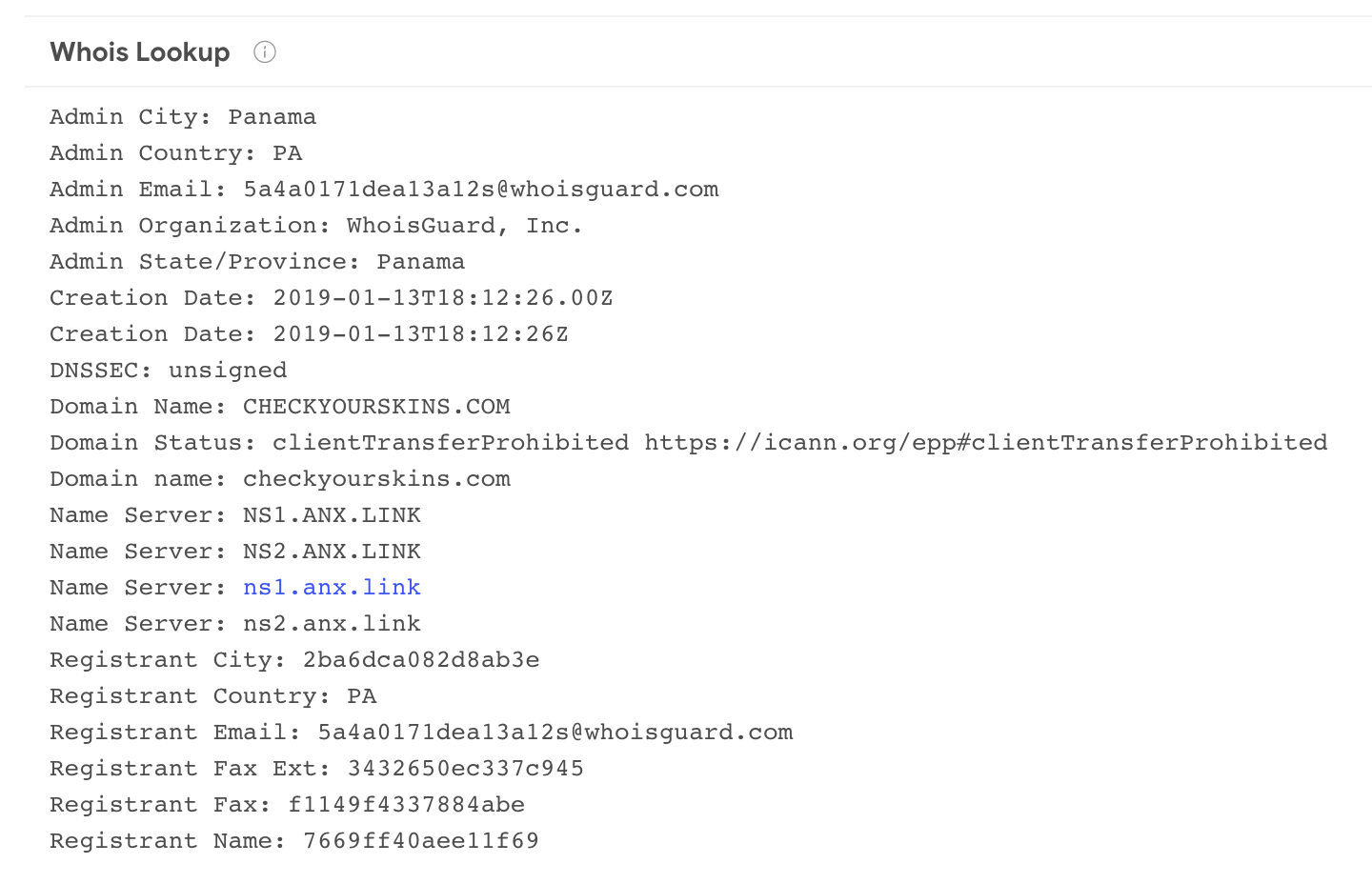
“We hit pay dirt. Whois records for both of these name servers reveal more than a thousand additional malicious domains using similar naming conventions.”

Name servers:
ns1.anx[.]link
ns1.anx-dns[.]link
ns1.anxdns[.]io

We can craft a whois search to identify other domains making use of the same name servers
entity:domain whois:"ns1.anx.link"

We can also do it at the DNS records level:
entity:domain ns_record:"ns1.anx.link"
entity:domain txt_record:"tsdomain"

Note that all these pivots surface as quick links on basically every section in the details of observable reports, meaning that when looking at a particular IP/domain you can immediately jump to other related infrastructure:


This is something that applies to pretty much every information block, not only to the Whois lookup. For example, you may click on an SSL thumbprint to discover other IPs that make use of a given SSL certificate. This builds upon our existing capabilities to discover other infrastructure operated by a same group, namely our pDNS dataset:
https://www.virustotal.com/gui/ip-address/206.54.170.81/relations

Other interesting commonly reused artefacts that can be searched for are trackers or cookie names.

Protect your brand and discover phishing campaigns


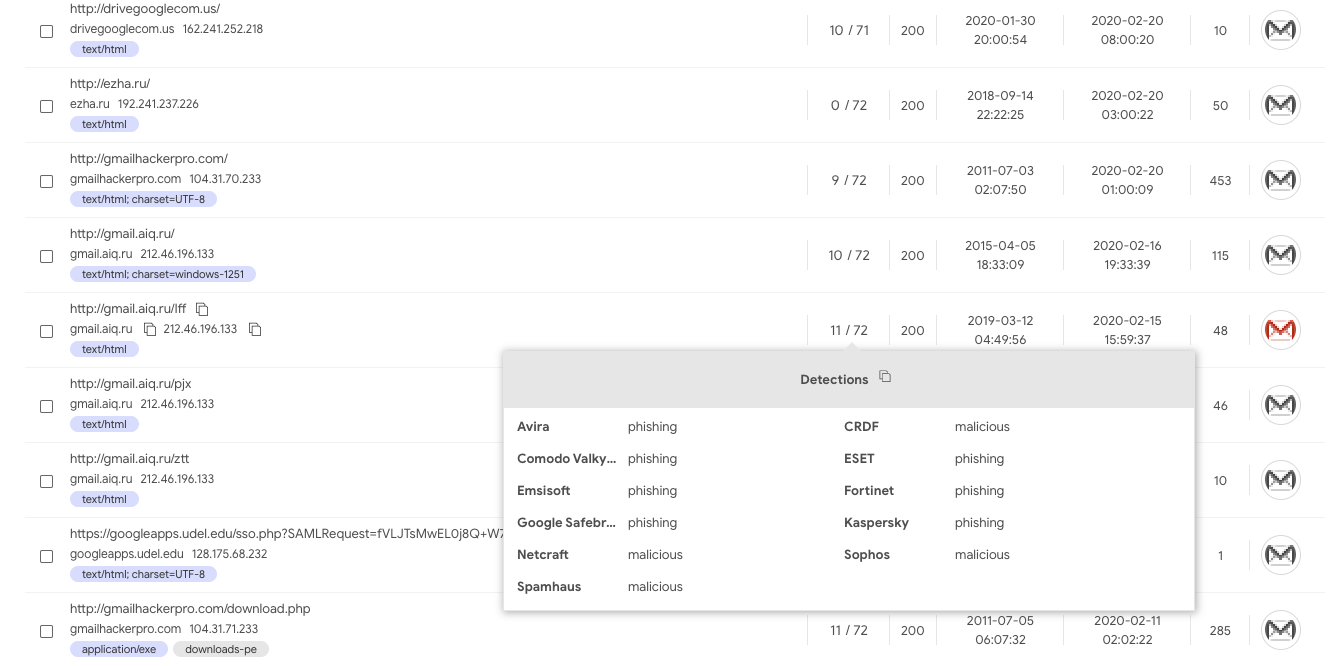
Phishing sites against a particular bank or online service will often make use of typosquatting or will contain the name of the given service as a subdomain of an illegit domain. This allows investigators to find URLs in the dataset that do not belong to the original brand:
entity:url hostname:"*gmail*" p:1+

This said, sometimes the attackers will avoid including the legit name in the domain string so as to prevent easy detection. In those cases we can still discover new phishing campaigns. For instance, let us focus on websites that make use of GMail’s favicon:
https://www.virustotal.com/gui/search/entity:url%20main_icon_dhash:%2200e8e0968ee8d48a%22/urls


Similarly, we can look into certain indexed metadata, such as the title of the page or meta tags:
entity:url title:"Sign in - Google Accounts" p:5+

More generally, you might just be interested in keeping up with the phishing landscape:
entity:url AND (category:phishing OR engines:phishing) AND positives:3+


Feed your IDS/SIEM/webproxy blocks, etc. with IoCs based on anomalous or suspicious patterns


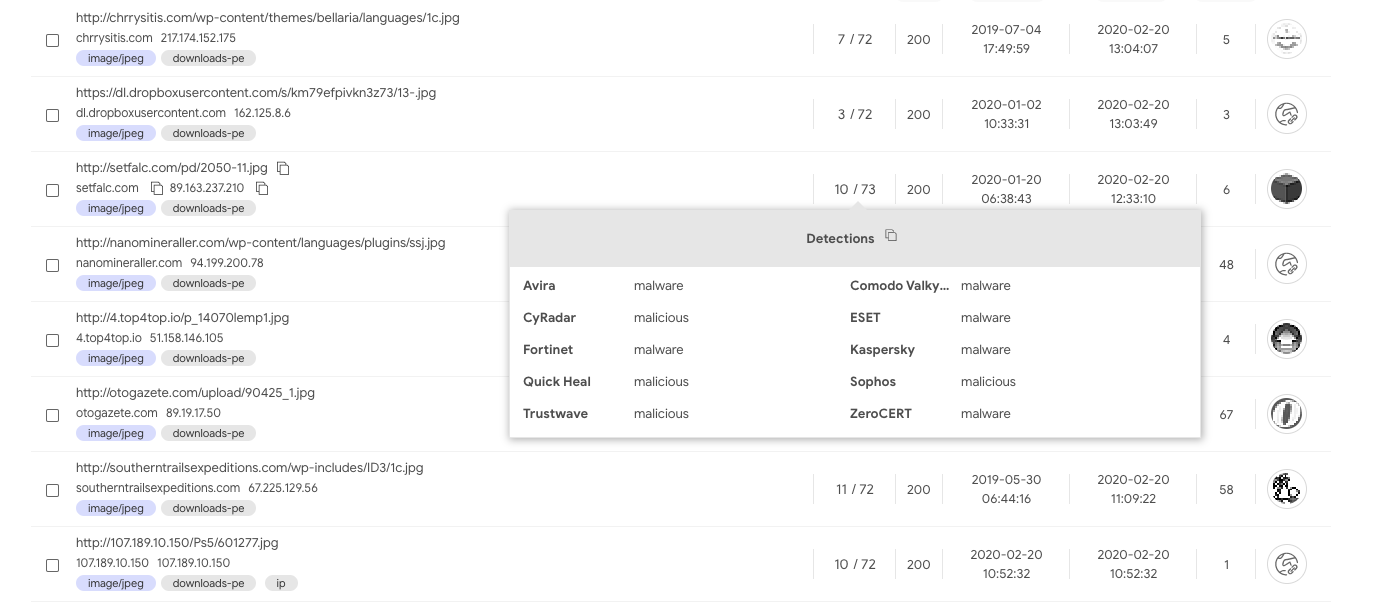
Sometimes you do not really know what you are hunting for, but you can unearth threats by focusing on highly suspicious sightings. Why would someone configure a server to return an “image/jpeg” HTTP response header when serving a Windows executable? The only reason is probably to try to circumvent very basic web proxy filtering:
entity:url header_value:"image/jpeg" tag:downloads-pe


This logic can also be applied to URL paths, the extension modifier tries to identify file extension within URL paths:
entity:url extension:jpg tag:downloads-pe

On this front, identifying double extension tricks also comes to mind as an easy hunting dork:
entity:url path:".jpg.exe"

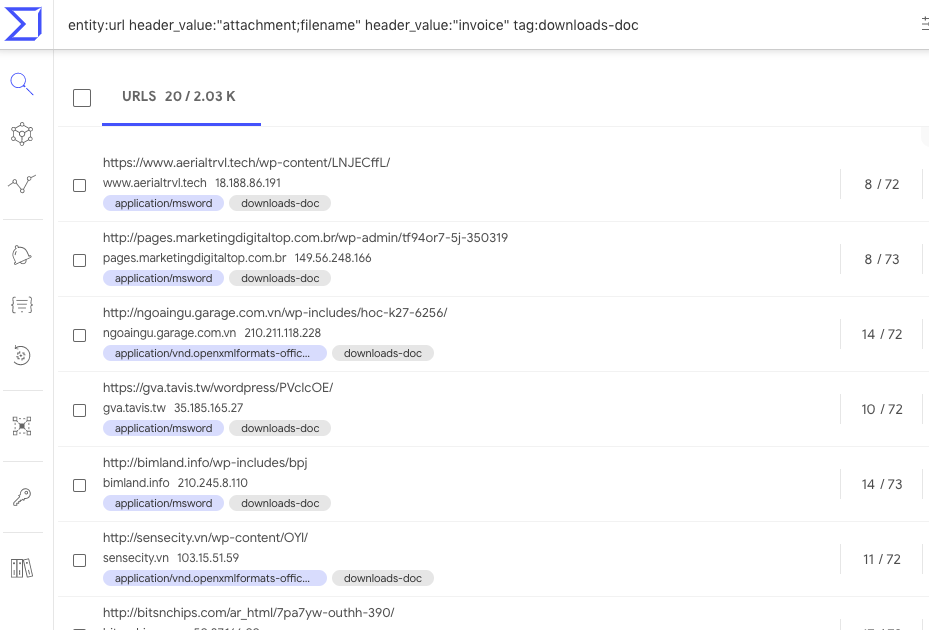
Similarly, attackers tend to reuse deception techniques such as spamming users to deceive them into downloading malicious documents that claim to be some kind of invoice or payment request (e.g. Emotet spreading):
entity:url header_value:"attachment;filename" header_value:"invoice" tag:downloads-doc
entity:url header_value:"attachment;filename" header_value:"payment" tag:downloads-doc


Executable downloads on non-standard HTTP ports are often worth deeper inspection:
entity:url tag:downloads-pe port:81+ NOT port:443 NOT port:8080

Open directories are also a common place to hunt for malware:
entity:url tag:opendir tag:contains-pe p:1+

As well as executables served via bare IP address URLs that are repeatedly submitted to VirusTotal:
entity:url tag:ip tag:downloads-pe submissions:20+

Same goes for DGA-like patterns:
entity:domain tag:dga detected_communicating_files_count:10+ communicating_files_max_detections:10+

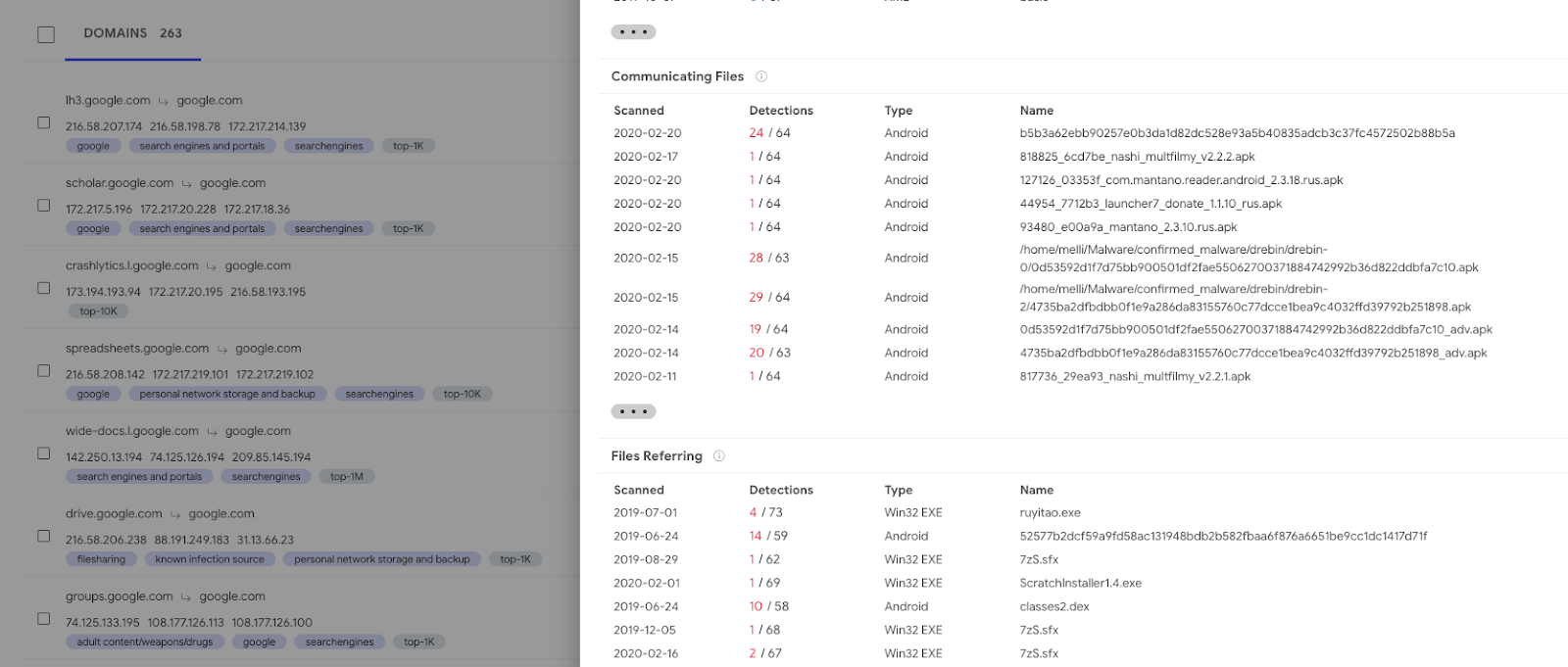
Malicious domains can also be surfaced by focusing on their relationships, in these cases we do not track particular actors or campaigns but rather high numbers of malicious sightings around the pertinent network locations:

entity:domain detected_downloaded_files_count:1+ detected_urls_count:1+ detected_communicating_files_count:1+ detected_referring_files_count:1+

entity:ip detected_downloaded_files_count:1+ detected_urls_count:1+ detected_communicating_files_count:1+ detected_referring_files_count:1+

When considering detections of connected entities, probably the most interesting search is to identify undetected URLs that download some kind of malicious file:
entity:url positives:0 response_positives:10+

All of these suspicious sightings can be extended to your own organization’s properties in order to dig deeper into threats that interact directly with your domains or IP ranges:
entity:domain domain:"*.google.com" detected_communicating_files_count:10+ communicating_files_max_detections:10+


Filters on the IP address CIDR are also allowed, to focus exclusively on your network ranges:
entity:ip ip:"35.224.0.0/12" AND ((detected_communicating_files_count:10+ communicating_files_max_detections:10+) OR (detected_downloaded_files_count:10+ downloaded_files_max_detections:10+))

All of this said, we acknowledge that the current facets and indexed data might not be perfect. Over the coming months we will be adding new modifiers based on more use cases that you may have, so please do not hesitate to contact us with suggestions and feature requests. We are pretty certain that one the most prevalent asks will be to expose some kind of YARA-like Livehunt capability in order to set up notifications for new network-level sightings: more on that front later this year.

The described functionality is now also exposed via APIv3:
https://developers.virustotal.com/v3.0/reference#intelligence-search
https://github.com/VirusTotal/vt-py

Oh, and one last thing, you may have already noticed that we recently added domain and IP address verdicts to extend the reputation capabilities that we already offered for files and URLs.

Happy hunting!

Friday, October 17, 2014

, , , , , ,

virustotal += Baidu-International URL scanner

And we are in our sixties with respect to the number of URL scanning engines integrated in VirusTotal, welcome Baidu-International! Not so long ago we introduced their file scanner and today we are excited to populate the malicious URL dataset with their verdicts.

In their own words:
Baidu Antivirus is a permanently free and easy-to-use antivirus software which offers proactive defense, file protection, USB protection, download protection, browser protection, and other professional security features. 
As part of the browser protection component they offer they come across and have to research many malicious URLs per day, these URLs will now trigger alerts on VirusTotal. An example of their engine in action can be found below:
https://www.virustotal.com/en/url/000feb4703a2f1b3a84ad435c46da9f523ea9daec84747b12bf8345ef2908de8/analysis/1413373146/

Welcome Baidu-International!

Wednesday, September 24, 2014

, , , , , ,

virustotal += PhishLabs URL scanner

Yet another malicious URL dataset is joining virustotal today. Welcome PhishLabs.

In their own words:
PhishLabs provides cybercrime protection and intelligence services that fight back against online threats and reduce the risk posed by phishing, malware, and other cyber-attacks. They fight back against online threats by detecting, analyzing, and proactively dismantling the systems and illicit services cybercriminals depend on to attack businesses and their customers.

As part of the investigations that they conduct and the Intelligence that they gather, PhishLabs comes across many malicious URLs every day, from now on virustotal checks will also run against their blacklist, enhancing users' ability to detect recent threats.

An example of a report containing an PhishLabs report can be found below:
https://www.virustotal.com/en/url/0ec471bc92bb025a95945ba57004d23cc5854bb8ce686a02f92375cdccffa341/analysis/

Welcome PhishLabs!

Tuesday, July 29, 2014

, , , , , ,

virustotal += OpenPhish URL scanner

We keep increasing the number of engines integrated in virustotal's URL scanning backbone. Today is the turn of OpenPhish. OpenPhish is a service developed by FraudSense, whose engine was integrated a couple of weeks ago, that serves as a free repository of phishing sites detected with FraudSense's Phishing Detection Technology.

In their own words:
OpenPhish is a free service that provides a continuously updated feed of global phishing URLs that were detected by FraudSense's Phishing Detection Technology. The feed includes phishing sites from the past 7 days and is updated in real time with newly detected ones.
The feed is publicly available at:
http://www.openphish.com/

It is also served as plain text at the following URL:
http://www.openphish.com/feed.txt

An example of a report containing an OpenPhish report can be found below:
https://www.virustotal.com/en/url/7f50f5c8baf4671d4f0d54bc6b7d765292bfa9f922b6f382d1723a8d5d3fcb38/analysis/1406625327/

Hopefully this new addition will beef up virustotal's detection capabilities when it comes to phishing sites, which even though is an old scam, it is still very extended and a common threat for the average Internet user.

Welcome OpenPhish!

Monday, June 23, 2014

, , , , ,

VirusTotal += FraudSense

We are excited to announce the inclusion of FraudSense as a new URL scanning engine in VirusTotal. FraudSense offers services to automate and enable real-time detection of phishing sites and their targeted brands. They have developed their own in-house phishing detection technology, which they describe as:
Based on cognitive concepts, artificial intelligence and active learning, our innovative technology automates what has traditionally been a labor-intensive process and enables real-time detection of phishing sites and their targeted brands.
Key features include:
0-Day Phishing Detection: Early discovery of new, unreported phishing sites.Brand Recognition: Accurate identification of the targeted brand.Language-Independent: Detection of both English and non-English phishing sites.Self-Sufficient: Independent of community-sponsored blacklists.
FraudSense is exposing its phishing feed to VirusTotal, so that users can check whether a given URL is already in their blacklist and hopefully get yet one more second opinion that will help them in keeping their environments safe.

An example of a URL detected by FraudSense:
https://www.virustotal.com/en/url/59c8caddf3295bfb72361d76ccb77f7405c6b4478ed4391eee7a9e80929734a8/analysis/

Welcome FraudSense!