Showing posts with label graph. Show all posts

Wednesday, October 20, 2021

, , , , , ,

VirusTotal Multisandbox += Microsoft Sysinternals

We welcome the new multisandbox integration with Microsoft sysinternals. It was also recently announced on the sysinternals blog as part of their 25th anniversary. This industry collaboration will greatly benefit the entire cybersecurity community helping put the spotlight on indicators of compromise that may be seen if malware is detonated within your own environment.


In their own words:

"The new Microsoft Sysinternals behavior report in VirusTotal, including an extraction of Microsoft Sysmon logs for Windows executables (EXE) on Windows 10, is the latest milestone in the long history of collaboration between Microsoft and VirusTotal. Microsoft uses VirusTotal reports as an accurate threat intelligence source, and VirusTotal uses detections from Microsoft Defender Antivirus and Microsoft Sysinternals Autoruns, Process Explorer and Sigcheck tools. This cross-industry collaboration has a significant impact on improving customers protection. " says Andi Comisioneru, Group Program Manager, Cloud Security, Microsoft.


Let's take a look at a few example reports. For example in the file with sha256 1bb93d8cc7440ca2ccc10672347626fa9c3f227f46ca9d1903dd360d9264cb47

Here we see a report from Microsoft sysinternals sysmon with DNS resolutions, process tree and shell commands:


From the DNS resolution seen, we can make use of VT-Graph to pivot on other samples that also resolve the same hostname.


For our second example let's look at 1247bb4e1d0aa5aec6fadccaac6e898980ac33b16b69a4aa48fc6e2fb570141d.  Here we see a suspicious email address contained within some files written to the disk:


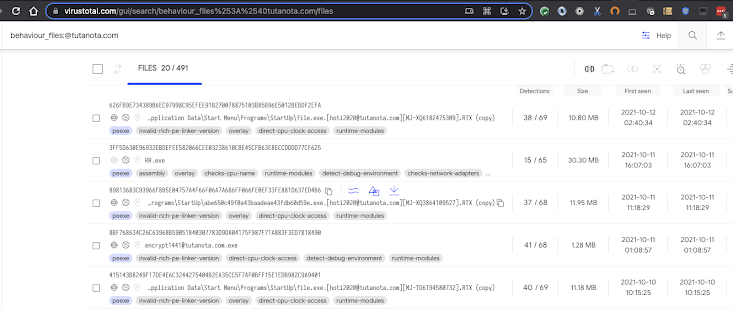
If we wish to pivot on that, we can search for other similar samples with the same modus operandi with a search query like:
behaviour_files:@tutanota.com


Finally our last example is:

4bb1227a558f5446811ccbb15a7bfe3e1f93fce5a87450b2f2ea05a0bca36bb2. This sample is a coinminer that stores a dropped file in %USERPROFILE%\AppData\Roaming\Microsoft\Telemetry\sihost32.exe

It also registers a scheduled task on logon. It is possible to find other samples doing the same thing with the following intelligence query:
behaviour_processes:"\"AppData\\Microsoft\\Telemetry\\sihost32.exe\""

For more ways to search, see documentation on the available file search modifiers.
 

Happy hunting!

Thursday, November 05, 2020

, , , ,

Keep your friends close; keep ransomware closer

“How to avoid being a ransomware victim?” is one of the main questions every single company and organization asks themselves every day. Unfortunately there is no silver bullet against that, but there are several good practices we can follow to minimize our exposure.

We can start by enumerating what are the main vectors that attackers use to get into victims: phishing, brute forcing and the use of exploits. Let's use this information to understand what exactly are attackers doing from a technical point of view, but more importantly, to monitor how their campaigns evolve. And here we want to highlight the importance of continuously tracking malicious activity in order to feed our systems accordingly: attackers evolve their methods and the IOCs used constantly change. We need the whole movie, not just a static picture.

This post describes different examples of techniques we can use to monitor ransomware campaigns, with a special focus on the infection vectors previously mentioned in order to minimize the risk of becoming a victim.

For more details, you can check our recorded anti-ransomware webinar in English and Spanish.

Ransomware in phishing attacks

Phishing is the most common technique used to distribute ransomware. We want to be able to discover how it is being used in new ransomware campaigns and to obtain the infrastructure behind the attack, gathering valuable IOCs and TTPs to feed our defenses.

We can start looking for emails involved in phishing campaigns uploaded this year to VirusTotal:

engines:ransom type:email fs:2020-01-01+

We get a list of generic ransomware email files. We can specify a certain malware family we are interested in. For instance, the following query returns emails related to some of the most common campaigns:

(engines:bitpaymer OR engines:maze OR engines:Ryuk OR engines:gandcrab OR engines:clop OR engines:revil OR engines:sodibiniki OR engines:matrix) type:email

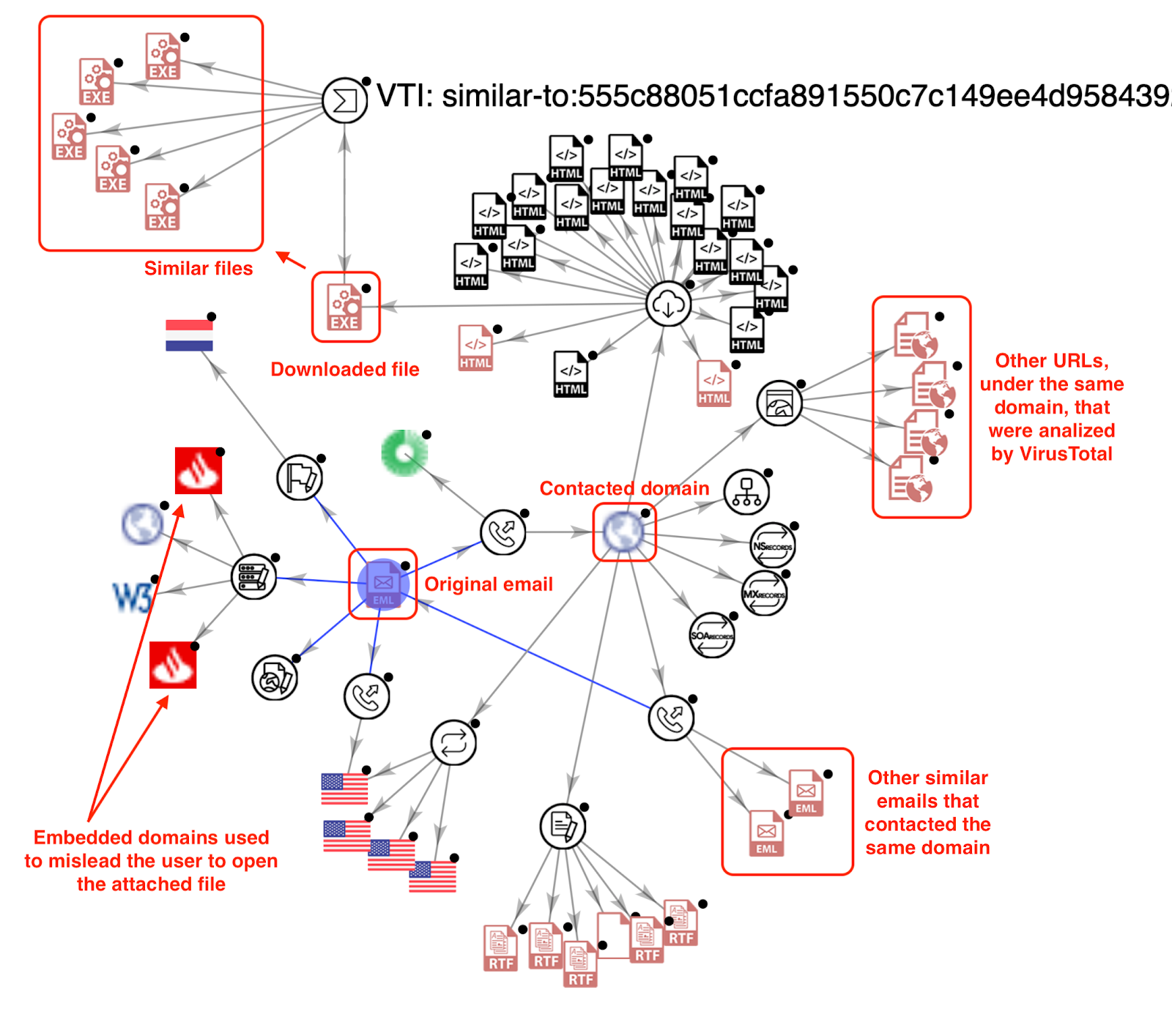
Trickbot is a malware family frequently used to distribute ransomware. By searching for recent samples delivered by email (engines:trickbot fs:2020-09-01+ type:email) we can quickly find an interesting sample implementing an exploit and pretending to be a well known financial institution. We can quickly expand all the domains, URLs and IP addresses embedded into this file into our investigation graph, getting a broader overview of the campaign:


Expanding different nodes uncovers new IOCs to feed our defenses and unfolds this campaign, showing domain names that were used to bait victims into opening the malicious word document attached to the phishing email. 


This kind of phishing attacks where legitimate logos, domains and brand images are used to bait victims into executing malware can hurt a company's reputation, not to speak of being used against the company itself. The sooner we detect a campaign the faster we can perform actions to shut it down. VirusTotal’s Livehunt checks any submitted file against a search criteria written in Yara.

For example, to check for embedded domains in emails detected as phishing, we could use:

import "vt"
rule brandmon_google {
    strings:
        $domain1 = "accounts.google.com"
        $domain2 = "mail.google.com"
        $domain6 = "drive.google.com"
    condition:
        for any engine, signature in vt.metadata.signatures : (
            signature contains "phishing" and vt.metadata.file_type == vt.FileType.EMAIL and (any of them)
        )
}


Exploits used in ransomware attacks

Exploits are commonly used for installing malware or for escalating privileges into your system.

According to this report, the four CVEs that are most frequently used for performing ransomware attacks this year are:
  • CVE-2019-19781 → Revil/Sodinokibi, Ragnarok, DopplePaymer, Maze, CLOP y Nephilim.
  • CVE-2019-11510 → Revil/Sodinokibi y Black Kingdom
  • CVE-2012-0158 → EDA2 y RASOM
  • CVE-2018-8453 → Revil/Sodinokibi
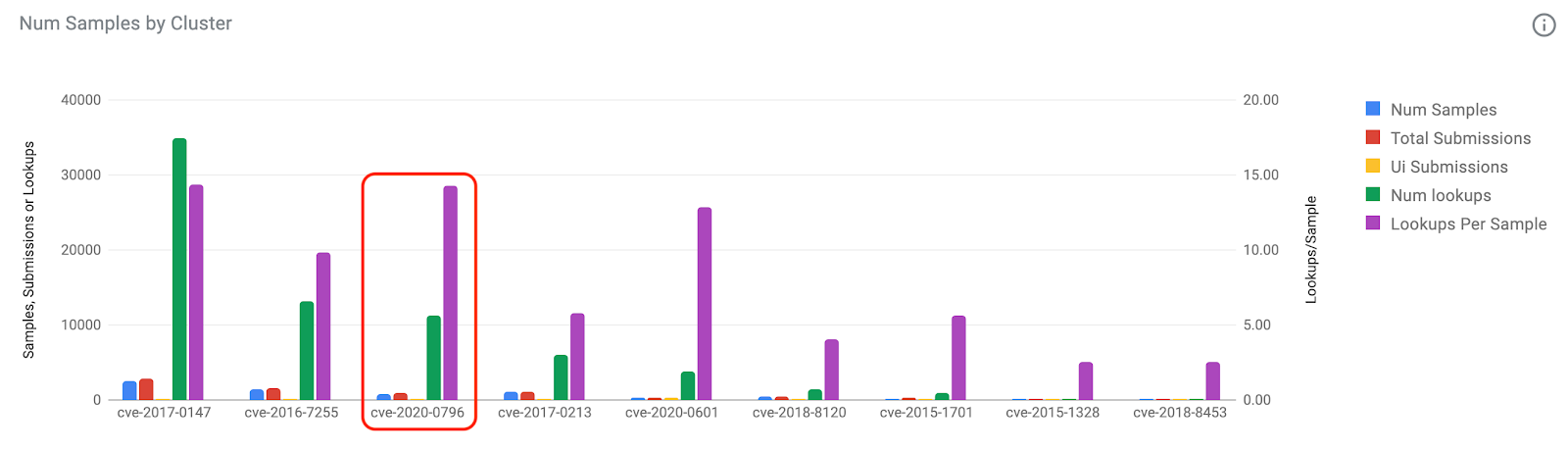
We can add to the list a couple of recent remarkable exploits: zerologon (CVE-2020-1472) and SMBGhost (CVE-2020-0796). We observed several ransomware lookups in VirusTotal tagged with this last vulnerability during the last months:


We could use the following query to get more detailed information about what CVEs were used in ransomware attacks during 2020:

engines:ransom tag:exploit fs:2020-01-01+ tag:CVE-2020*

We can once again filter by malware families. For instance, the previous query is mostly GandCrab malware, which can be easily checked using the query: (engines:ransom and not engines:gandcrab) tag:exploit fs:2020-01-01+ tag:CVE-2020*).

Now, we are ready to create a Livehunt rule to find new files tagged with one of the exploits frequently used by ransomware. 

import "vt"
rule ransomware_exploits {
    condition:
        for any tag in vt.metadata.tags : (
            tag == "cve-2019-19781" or
            tag == "cve-2019-11510" or
            tag == "cve-2012-0158" or
            tag == "cve-2018-8453" or
            tag == "cve-2020-1472" or
            tag == "cve-2020-0796"
        ) and not vt.metadata.file_type == vt.FileType.CAP
}

This will result in an immediate notification, allowing us tracking any new IOCs we can use to protect our system.

More importantly, this is very valuable information we can use on a regular basis to manage our patching policy, prioritizing patches based on fresh data of how different exploits are being used in real attacks.

Tracking fresh campaigns

Now, we want to make sure that we monitor any new ransomware campaign in order to understand how it evolves and what new artefacts and techniques they use.

As an example, we can start with a recent DFIR Report investigation revealing Ryuk exploiting zerologon. There are many ways to track campaigns, however VT Graph is a great choice to get together all the discovered observables and extend our knowledge in a visual way. Here are some tips that could help you during this process:
  • Start by adding all the known observables to a new VT Graph.
  • Expand domains, URLs and IPs to unfold relations and obtain new observables.
  • In order to keep our list of observables up to date, we can translate common Yara rules into Livehunt rules to catch new files, injecting Livehunts results directly into the graph.
  • Additionally, we can use Retrohunt rules to look for similar samples in our collection.
We start the investigation dropping one of the files included in the publication in a new graph, showing domains, urls and ip addresses embedded in the file, ITW URLs hosting the file and network observables contacted by this sample when executed. This file is detected as “bazar” malware, used to install Ryuk. We dropped all this information in our graph:


Additionally to keep pivoting using our graph and indicators, we can also translate the Yara rules from the DFIR report into Livehunt rules.


We can integrate Livehunt results into our graph in just two clicks. Just click on the target icon at the right in the VTGrap interface, select the rule desired and choose "Load results". This will add all the new observables that match our rules to the current graph. We can expand these new nodes to unveil new observables and create relationships.


All these new IOCs are fresh observables that are clearly related to this campaign. All this continuous flow of fresh indicators will help us improve our security mechanisms to stop Ryuk from passing through our defenses.

Summarizing, the knowledge of what attackers are using is the first necessary step for us to minimize our exposure to different campaigns. It wouldn't be right to put all the different ransomware attacks under the same umbrella, as they became highly specialized and protecting from different actors is not exactly the same. The techniques described in this post are a good starting point for automatically minimizing our exposure to more spread ransomware campaigns, however they can be applied both for generic and targeted attacks.

Stay safe and happy hunting!


This post was co-authored by Vicente Diaz.

Wednesday, January 22, 2020

, , , , , ,

VirusTotal Graph++

Just 2 years ago we launched the first version of VirusTotal Graph. The goal was to provide a tool which understands the relationship between files, URLs, domains and IP addresses, and an easy interface to pivot and navigate over them.

To continue in this direction, today, we are releasing a set changes to help your investigations with VirusTotal Graph.

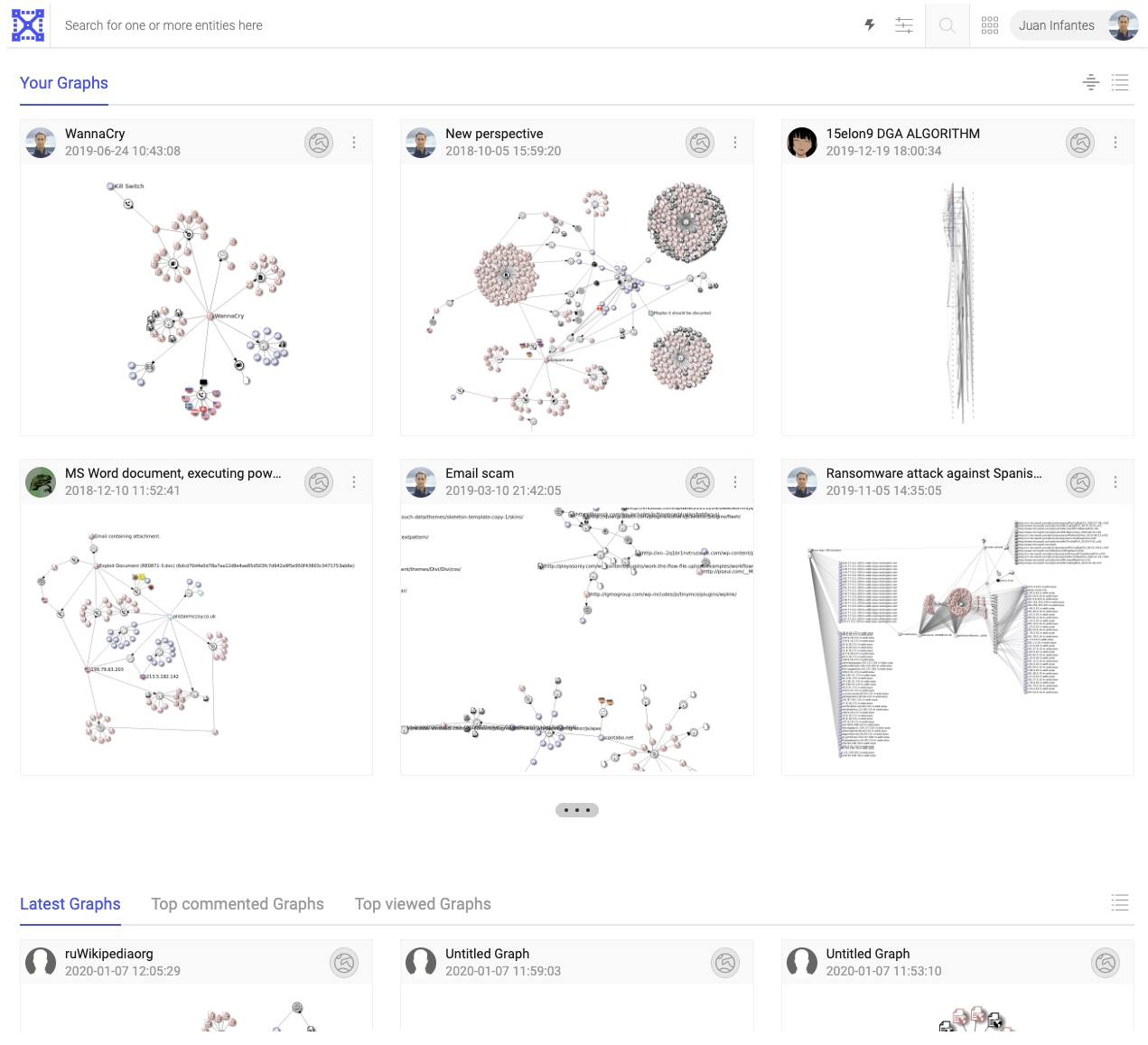
1. We have created a dashboard where you can see your graphs and the graphs created by the community.


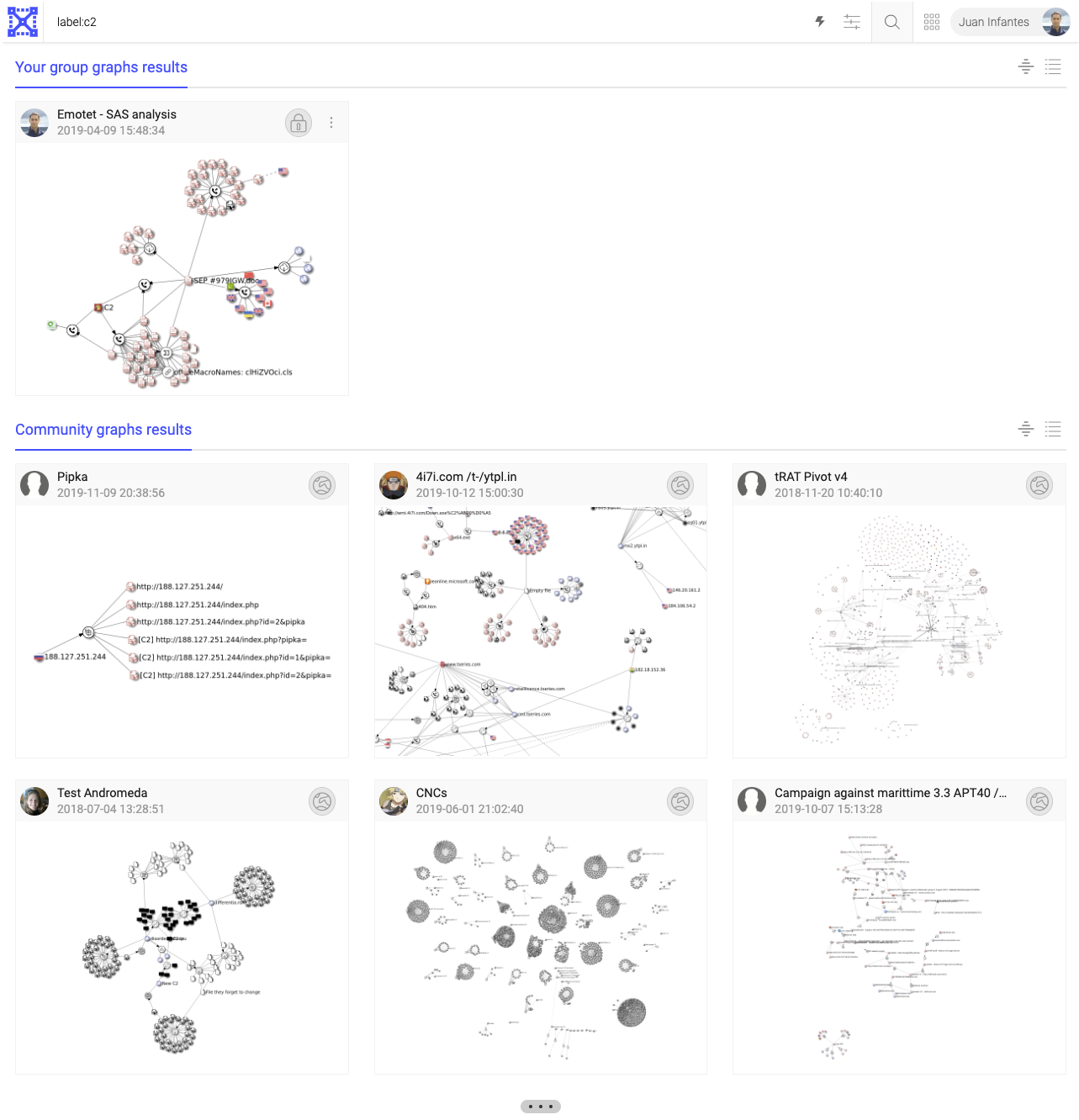
You can also search for graphs with certain features, for example, graphs that contains a node with a label “c2”. The searches will go simultaneously to the public graph repository and to your private repository.


You can see the full list of search modifiers here.

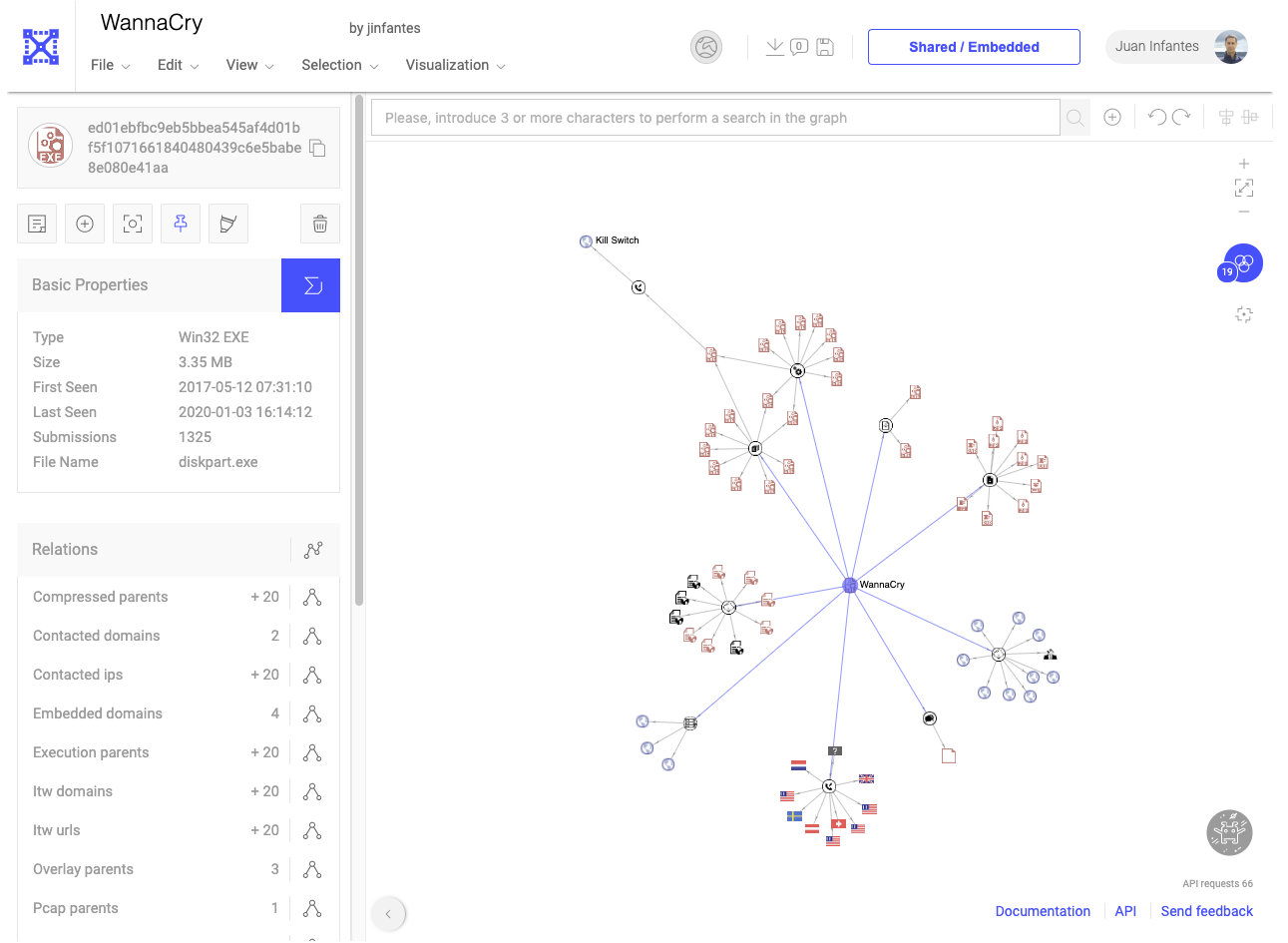
2. We’ve improved the VirusTotal Graph UI with these features, most of them coming from our power users:
  • Undo/redo
  • In graph search
  • Download the graph as JSON and as image
  • Align nodes horizontally and vertically
  • New ways of visualizing the graph
We’ve also included some extra features for our premium customers:
  • Removed the API usage. If you are a premium customer you can use VT Graph extensively, its consumption won’t count against your API quota
  • Added more commonality calculations
  • Integration with VT Hunting - link


3. As most of our other products, VirusTotal Graph is getting a restful API. The documentation can be found here and a Python library to reduce the learning curve; it is available in our Github repository.

In the meanwhile we are cooking very exciting enhancements that we really hope will please the Community, stay tuned. As always, we would love to hear from you.

Tuesday, January 08, 2019

, , , , , ,

Multisandbox project welcomes ReaQta-Hive

We are pleased to announce the addition of ReaQta-Hive to the multisandbox project, after the integrations of Tencent Habo, VirusTotal Droidy, Cyber adAPT ApkRecon, and Dr. Web vxCube. The unique new feature that this integration brings is XSL documents in addition to  PE files, PDF, MS Office documents and scriptlets.

In their own words:

ReaQta-Hive is an Endpoint Threat Response and Hunting platform that uses A.I. to detect new types of attacks. A live hypervisor, called the NanoOS, collects detailed security information at the lowest possible level of an endpoint, which Hive uses to perform dynamic behavioral analysis. This analysis is automatic and constructs a comprehensive storyline of an attack. The end result is an intuitive report of all the actions carried out by an attacker, including a summary of the meta-behaviors that highlight key components of the attack. ReaQta-Hive is a vector-agnostic platform, so it can analyze the behavior of any type of attack, whether it is file-less, script-based, exploit driven, or a plain executable file. We are happy to use our software and expertise to contribute actively to the VirusTotal community, and to help analysts worldwide be more effective and efficient.


To view the ReaQta report when viewing a file analysis, click on the Behaviour tab, select  ReaQta-Hivethen the detailed report.


In the detailed report, you can view copious amounts of information obtained by ReaQta-Hive:


Lets take a look at some example use cases where this data is interesting. 

XSL document  / #squiblytwo

This example is an interesting malicious XSL document which only ReaQta processes:
https://www.virustotal.com/#/file/9d3746779bc2b2d1ecbd90da8626f81978db4be1eb346106a6334295fce568cd/behavior 
In the relationships tab you can see a  link to VT Graph where you we can see some relationships to other domains and URLs VirusTotal has seen before.


Malicious document using LOLBins

Malicious code using Living off the land binaries and scripts (LOLBins) have become popular since they are binaries/scripts that are included with the operating systems, hence trusted. Here is a MS Office trojan that does so: 
https://www.virustotal.com/#/file/1f4f22f1814712880b2bbdc5c6418aeaf08c598be0990c5fad55136c9e769951/behavior 


Windows PE file, detecting behaviors like  key-logging/screenshots

https://www.virustotal.com/#/file/d72f74208c8960ae70469af3968324c6d5f90a305931763c0f5e23cd7922bcea/behavior
In the report we can see the detection and severity: