Monday, April 24, 2023

Introducing VirusTotal Code Insight: Empowering threat analysis with generative AI

At the RSA Conference 2023 today, we are excited to unveil VirusTotal Code Insight, a cutting-edge feature that leverages artificial intelligence for code analysis. Powered by Google Cloud Security AI Workbench, Code Insight produces natural language summaries of code snippets with ease. This functionality empowers security experts and analysts by providing them with deeper insights into the purpose and operation of analyzed code, significantly enhancing their capability to detect and mitigate potential threats.

For quite some time, artificial intelligence (AI) and machine learning (ML) have played a crucial role in anti-malware and cybersecurity, mainly focusing on classification tasks. However, recent advancements in large language models (LLMs) have expanded their capabilities to encompass text generation and summarization. 

Impressively, when these models are trained on programming languages, they can adeptly transform code into natural language explanations. This innovation not only expedites malware analysis but also bolsters a variety of cybersecurity applications. Recognizing the immense potential of this cutting-edge technology, we have incorporated it into the VirusTotal platform, significantly enhancing its capabilities.

Code Insight is a new feature based on Sec-PaLM, one of the generative AI models hosted on Google Cloud AI. What sets this functionality apart is its ability to generate natural language summaries from the point of view of an AI collaborator specialized in cybersecurity and malware. This provides security professionals and analysts with a powerful tool to figure out what the code is up to. 

At present, this new functionality is deployed to analyze a subset of PowerShell files uploaded to VirusTotal. The system excludes files that are highly similar to those previously processed, as well as files that are excessively large. This approach allows for the efficient use of analysis resources, ensuring that only the most relevant files (such as PS1 files) are subjected to scrutiny. In the coming days, additional file formats will be added to the list of supported files, broadening the scope of this functionality even further.

Let's examine a few examples derived from authentic situations to truly appreciate the functionality of this feature. 

In this first case, we have a file that was detected by only three engines on VirusTotal as “PowerShell/PSW-Agent.U” and “HEUR.Trojan-PSW.Multi.Disco.gen”. Meanwhile, Code Insight provided the following explanation:
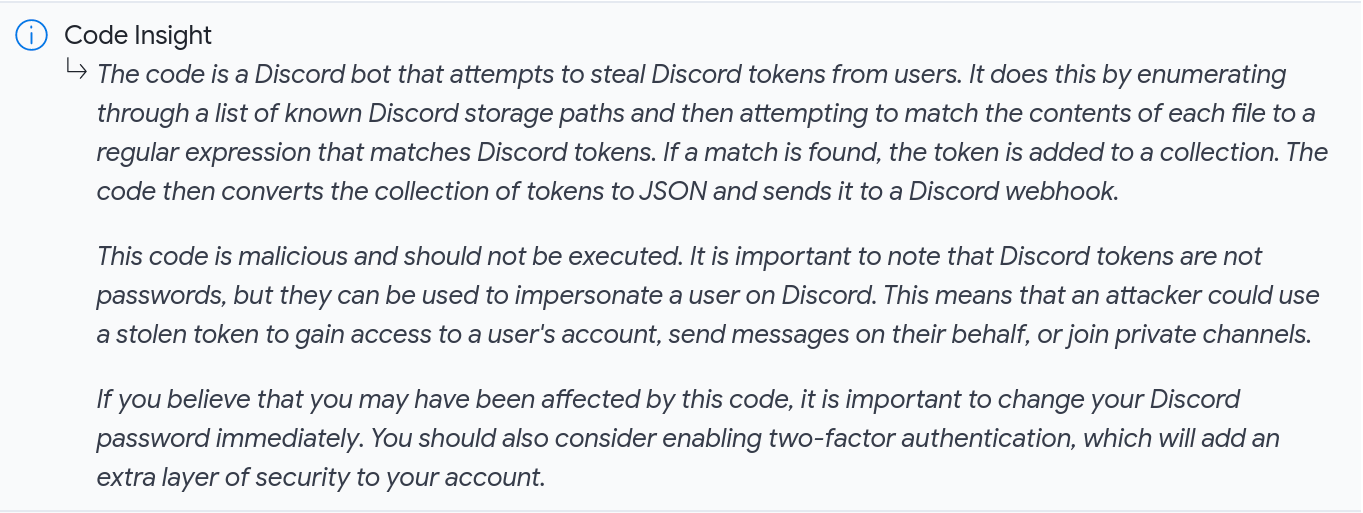


https://www.virustotal.com/gui/file/74662107227a6a28bebb77d5b9ec3890a80e507ee22ed99eb17f35c9d8730bf3/detection

Unveiling false negatives


It's important to note that Code Insight conducts its analysis independently, relying solely on the content of the file being processed, without access to antivirus results or any other associated metadata. A good example can be observed in this case of a false negative, where Code Insight’s explanation helps us detect malware to stealth user’s credentials that has not been identified by any antivirus software in VirusTotal:


https://www.virustotal.com/gui/file/552efb0dc7e62ded08c98d2e6355df1d27a1317c0a37aabeefd48667b7b1917b/detection

Clearing false positives


In this other example, we have a file that is flagged as trojan and malware by 9 antivirus engines, but it's actually a false positive. Here we can see once again how Code Insight can be a valuable ally when managing incidents and analyzing potential malware. In this case, it explains that it's simply a script that installs Postman CLI:


https://www.virustotal.com/gui/file/b5796d7e4a9efc0b81efdc94b3e42ba6a6ef71d10274e3b812cd5ef4dfb8787b/detection

In this last example, Code Insight demonstrates how it can help improve file categorization in VirusTotal. Code Insight accurately identifies the sample’s file type and fixes the tag that misclassified it as JavaScript.

Although the selected examples illustrate accurate descriptions, the performance of the LLM model may vary on a case-by-case basis, including judgment errors. It’s highly likely that attackers develop new evasive strategies and an ongoing competition between malware and this new approach is expected. That’s why it is crucial for a security analyst to oversee these features as they ultimately need to interpret this information combined with other contextual information and correlations relevant to the case at hand.

Nevertheless, the integration of LLMs into the arsenal of code analysis tools is a significant advancement that enables security professionals to gain valuable insights into the structure and behavior of potentially malicious code, improving threat detection and response efficiency.

Code Insight in VirusTotal Intelligence


This kind of analysis can be carried out by various AI models, each offering varying levels of precision and depth. However, the true value of VirusTotal's Code Insight lies in its capacity to scale this analysis through its platform. This enables not only the examination of individual code samples, but also the aggregation and exploitation of results on a large scale via the VirusTotal Intelligence service. As a result, security teams can swiftly and effectively scrutinize vast quantities of code and identify potential threats, enhancing their efficiency and ultimately fortifying their security stance.

Here’s an example of searching for ”codeinsight:keylogger”:


VirusTotal Intelligence finds several files that, according to the Code Insight report, record keystrokes and write them to a log file. Let’s expand the report of the first one, then we can read a comprehensive analysis explaining this specific keylogger’s behavior:


https://www.virustotal.com/gui/file/d6111869a8088e2d1b49a92a30fc3d477373d88a4a2f1a7da4e75ce85dc08ba4/detection

As we continue to refine and expand the capabilities of VirusTotal Code Insight and other cutting-edge features, we remain dedicated to providing our community with the most advanced and effective tools to stay ahead of evolving cyber threats. We are truly excited about what the future holds and are eager to continue pushing the boundaries of what is possible in the field of cybersecurity. Stay tuned for more updates and developments from the VirusTotal team.

Thursday, April 20, 2023

APT43: An investigation into the North Korean group’s cybercrime operations

Introduction 

As recently reported by our Mandiant's colleagues, APT43 is a threat actor believed to be associated with North Korea. APT43’s main targets include governmental institutions, research groups, think tanks, business services, and the manufacturing sector, with most victims located in the United States and South Korea. The group uses a variety of techniques and tools to conduct espionage, sabotage, and theft operations, including spear phishing and credential harvesting.

From VirusTotal we wanted to contribute to a better understanding of this actor’s latest activity based on their malware toolset’s telemetry, including geographical distribution, lookups, submissions, file types, detection ratios, and efficacy of crowdsourced YARA rules for the IOCs attributed by Mandiant to this threat actor. All the data provided in this post is also available for VirusTotal users through VT Intelligence. It can be obtained by aggregating Telemetry and Commonalities from a set of IOCs, which you can do using a VT Intelligence search, Collection or Graph. 

Malware artifacts

File type distribution

We used Indicators of Compromise (IOCs) attributed to APT43 by Mandiant to collect telemetry on the threat actor’s latest activity, resulting in the following file type distribution: 


Microsoft Word documents (docx) are the most common file format among the samples we analyzed. This suggests that APT43 relies heavily on Microsoft Word documents as a vector for delivering malicious payloads or exploiting vulnerabilities. We also found that most of these files used macros as their infection technique, while only a few of them exploited the CVE-2017-0199 vulnerability, which allows attackers to run malicious code on target systems by embedding malicious links in the docx file. 

The file type distribution also reveals interesting patterns. For example, we can see that there are more pedll files than peexe files, even though both are executable formats. Further analysis of the pedll files revealed that the majority of them used the T1129 MITRE ATT&CK technique, which involves executing malicious payloads via loading shared modules. Another example is that there are more hwp files than doc files, even though both are word processing formats. This may indicate that APT43 targets specific regions or organizations that use Hangul Word Processor (HWP), a popular software in South Korea.

Lookups and submissions timeline

The oldest of the samples we analyzed, a portable executable, was uploaded in July 2018 from the United Kingdom.  

The initial submission triggered only five positive detections, but after subsequent submissions from South Korea and Italy, the latest one being on March 30, there are now more than 40 detections. This is an important remark on how typical AV detections evolve protection as new techniques and artifacts are discovered.   


For user queries (lookups) now associated with APT43, which speak of the interest of VirusTotal’s users on particular samples, there was a peak around April 2021, maybe related to some particular APT43 campaign. The plateau starting July 2022 might be related to security companies monitoring this actor’s activity. The very recent peak in April 2023 is most likely related to the publication of APT43, which revamped the interest from security analysts on this actor and related artifacts. 


From January to April this year, most of the submissions came from South Korea, and the file type most associated with these submissions was the docx file. For lookups, most of them are from the United States with apk files being the most looked up, followed by docx, text, html, powershell, and peexe.


Geographical distribution

File sample submissions and lookups are important indicators of cyber threat activity and awareness. By analyzing the geographical distribution of these activities, we can gain insights into the regions that are most affected by or interested in a particular threat actor or campaign.

According to our telemetry data, the top countries for file sample submission are South Korea, the United States, Italy, Israel, and the United Kingdom.

South Korea stands out as the country with the most file sample submissions, accounting for almost half of the total submissions. This is not surprising, given that South Korea is (probably) the primary target of APT43, as pointed out by Mandiant. Submissions of the identified samples are observed from July 2018 to April 2023. 


On the other hand, South Korea ranks third in file sample lookups which is consistent with their leading position in file sample submissions. This is remarkable given South Korea’s number of VT submitters, well below top 10 countries.

Interestingly, Turkey stands out as the country with the second highest number of lookups, even if they are not among top submitters. This may suggest that Turkey is either a victim or a conduit of North Korean cyber attacks. Lookups of the identified samples are observed from October 2020 to April 2023.


Detections

Analysis from the commonalities tool reveals the most common threat categories as trojan, downloader and dropper. Of the identified samples, 32% of the samples with threat names assigned to them are labeled ‘kimsuky’. Mandiant’s report mentions kimsuky as being used by multiple companies in their public statements on APT43’s activities.

To get a sense of the detection distribution among the samples we analyzed, we divided them into four categories: 

  • 15 or more detections, 

  • less than 5 detections, 

  • between 10 and 15 detections, and 

  • between 5 and 10 detections. 

The most common category was for 15 or more detections, representing 83% of all samples. On the other hand, samples with less than 5 detections came in at 9.7%. The other two categories, between 5 and 10 detections and between 10 and 15 detections, came in at 2.4% and 4.8%, respectively.


MITRE ATT&CK

During our analysis of the samples using the commonalities tool, we observed several MITRE ATT&CK techniques adopted to APT43 to compromise and exfiltrate data from their targets. VirusTotal extracts TTPs from samples by detonating them in different sandboxes and using tools such as CAPA. Among the techniques, the most prevalent ones were:

  • T1082: System Information Discovery

  • T1083: File and Directory Discovery

  • T1129: Execution through Module Load

  • T1055: Process Injection

  • T1071: Application Layer Protocol

Crowdsourced YARA rules

Of all the samples analyzed, quite a few of them triggered some crowdsourced YARA rules. The YARA rule that detected quite a few of the samples was one created by InQuest Labs, Ruleset: Office_Document_with_VBA_Project. The rule was created to detect any Office document with a VBA project in them. While a VBA project within an Office document is used for automating tasks, it can also be used to perform a range of malicious actions such as stealing sensitive data, installing malware, and modifying or deleting data. It can even be used in phishing attacks where the emails contain attachments with malicious VBA macros. In Mandiant’s publication, they point out APT43’s use of SPICYTUNA, which is a VBA downloader. This rule could be used as a soft signal.

Another crowdsourced YARA rule that detected a few of the analyzed samples was one by Florian Roth, which detects the Ghost419 RAT used by the Gold Dragon malware: GoldDragon_Ghost419_RAT. Mandiant reports that the malware extracts a payload from a hwp document and writes it to a startup directory resulting in the new file being executed when the current user logs in.

A sample using the Gh0st RAT malware was detected by one of the crowdsourced rules: GhostDragon_Gh0stRAT. The malware is a backdoor written in C++ that communicates via a custom binary protocol over TCP or UDP, as reported by Mandiant.

Collections

Collections are how our users can group different indicators in a shareable set. This has great benefits, such as providing a name and description, external references, attribution, etc. In addition it helps working with large datasets and obtaining commonalities, telemetry and other aggregated data. Other than this, we daily create dozens of collections based on OSINT security incidents and publications.


During our analysis of the samples, we observed that several of them belonged to two different collections created by AlienVaultOTX: APT43: North Korean Group Uses Cybercrime to Fund Espionage Operations and Analysis of Smoke Screen in APT campaign aimed at Korea and America. For the first collection, we observed that it contained a variety of file types such as pedll, peexe, docx, php, and powershell in that order. The second collection was different, however, as it contained only two file types. We found that the majority of the files were docx files which accounted for over 90% of the samples, and the remaining were peexe files.


Conclusions

This blog post sheds light on the activities of APT43, a threat actor operating on behalf of the North Korean regime. We have used VirusTotal’s features to explore the file type and geographical distributions, detections, ATT&CK techniques, collections, and crowdsourced YARA rules related to the threat actor’s campaign. We hope that this post has provided some insights into the capabilities and techniques of APT43, and how VirusTotal can help to monitor and investigate such campaigns. 

We hope you found this useful, and please reach out to us if you have any suggestions or just want to share feedback.

Happy hunting!


Monday, April 03, 2023

VirusTotal += Deep Instinct

 We welcome Deep Instinct to VirusTotal. In their own words:

"Deep Instinct is the only prevention-first cybersecurity company with a natively architected deep learning platform. We keep enterprises safe by stopping >99% of threats before other solutions even see them – at a speed and scale, unprecedented in the industry. Deep Instinct significantly reduces detection noise and false alert storms to reduce overall risk, improve SOC team productivity, and improve the total cost of ownership of our customers' entire cybersecurity stack. For more, visit www.deepinstinct.com.”


Deep Instinct has expressed its commitment to follow the recommendations of AMTSO and, in compliance with our policy, facilitates this review by AV-Comparatives, an AMTSO-member tester.

Monday, March 13, 2023

,

Introducing VT4Splunk - The official VirusTotal App for Splunk

 TL;DR: VT4Splunk, VirusTotal’s official Splunk plugin, correlates your telemetry with VirusTotal context to automate triage, expedite investigations and unearth threats dwelling undetected in your environment. This extends Splunk’s own VirusTotal plugin for their SOAR. Next March 30th we will host a webinar along with Splunk to show how to do security investigations with Splunk and VirusTotal. Register here!

One of VirusTotal’s main use cases is technology integrations, where VirusTotal’s context is used for automatic security telemetry enrichment, false positive discarding, 2nd opinion detection (true positive confirmation) and incident contextualization + investigation. 

VirusTotal had Splunk plugins for a while, most of theme developed by community contributors and other 3rd-parties. For instance, VirusTotal’s plugin for Splunk SOAR, which ranks #1 in the Threat Intelligence Reputation space is developed by our friends over at Splunk, and we highly recommend it. 

However, we wanted to truly showcase what VirusTotal can do for your SIEM and VT4Splunk v1 is our proposed solutions. It is free and you can download it from Splunkbase. It is compatible with Splunk +8.x Enterprise and Cloud versions.


In a nutshell, VT4Splunk automatically enriches your Splunk logs with threat intelligence coming from VirusTotal, to gain superior visibility and understanding. Let’s dive into specific use cases and outcomes.

Expedite triage and investigations via on-demand command-line driven enrichment

When studying an alert or incident, analysts often need to sweep through hundreds or thousands of events to make sense of an attack. Narrowing down massive amounts of events to focus on those that are relevant in the context of an attack is complex and time consuming. 

VT4Splunk adds a command to trigger correlation of events with threat intelligence (reputation and context) from VirusTotal, which in turn allows you to perform subsequent filtering to focus on events that look particularly anomalous.

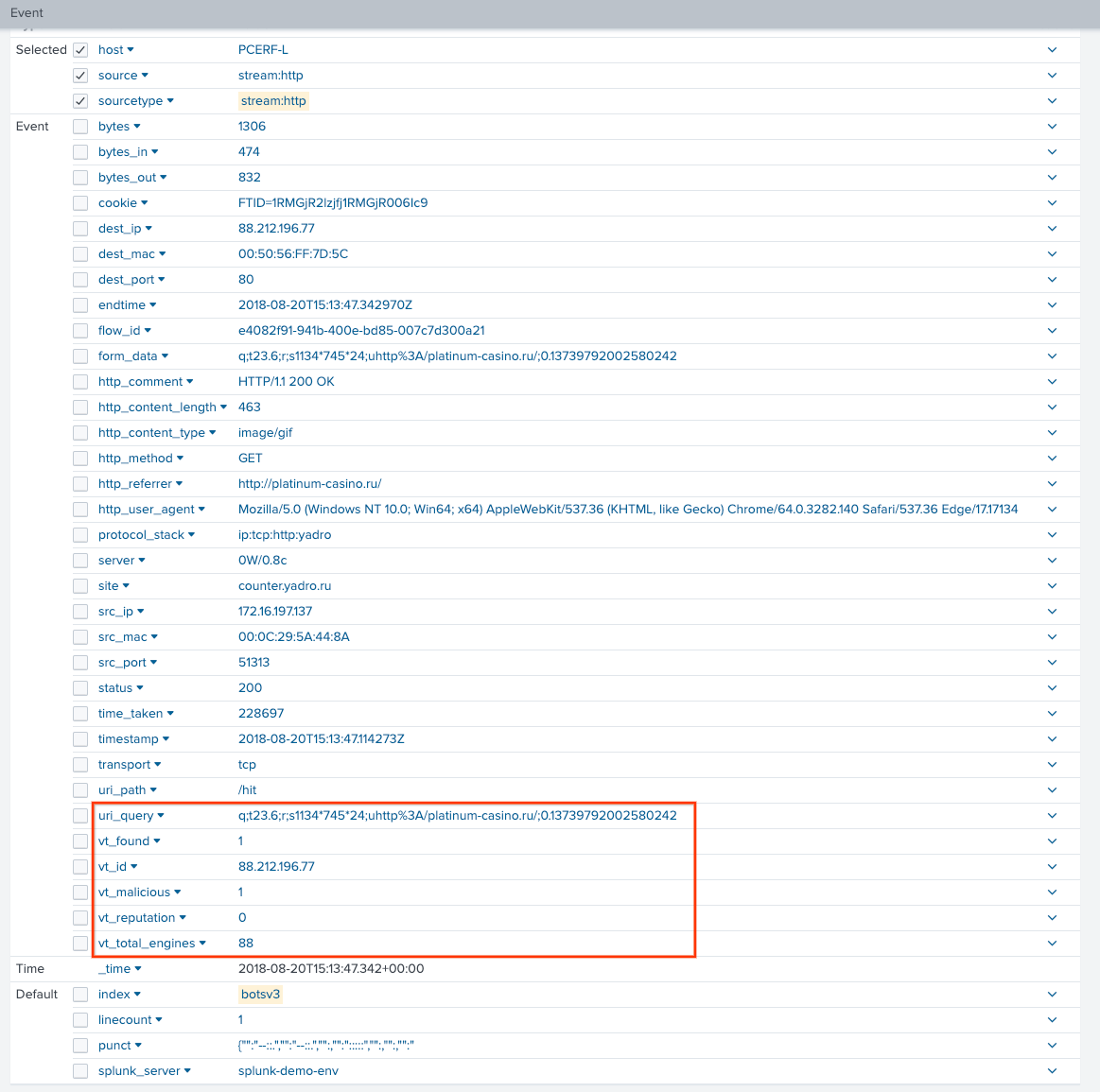
The "vt4splunk" command initiates the enrichment, it can be appended to any Splunk SPL query. For example, let's say you have run a query that returns all events related to a specific IP address. To enrich resulting events with information from VirusTotal, simply append the "vt4splunk" command to the query:

index=myindex sourcetype="stream:http" | vt4splunk ip=dest_ip

VT4Splunk will automatically retrieve information from VirusTotal for each IP address returned in the query results. This information includes the number of malicious detections, the first and last seen dates, and most importantly, context and analysis properties that can be used for triage and hunt missions:

This also applies to other observable types, such as file searches. The following example search enriches hashes found in Sysmon events:

index=botsv3 sourcetype="xmlwineventlog:microsoft-windows-sysmon/operational"
| vt4splunk hash=SHA256


The correlation is made via VirusTotal’s API and, thus, also understands domains and URLs found in events, beyond file hashes and IP addresses. 


Make better decisions and minimize missed threats with IoC contextualization via the VT Augment widget

Security teams are increasingly concerned about missed threats due to lack of context. Indeed, the use of reactive threat feeds, the adoption of ML and generic detections, the popularization of anomaly based detections and UEBA, etc. is leading to alerts where there is extensive context about the internal systems where a given anomaly was observed, but little context about the threat itself. This means that it is easy for analysts to discard true positives. 

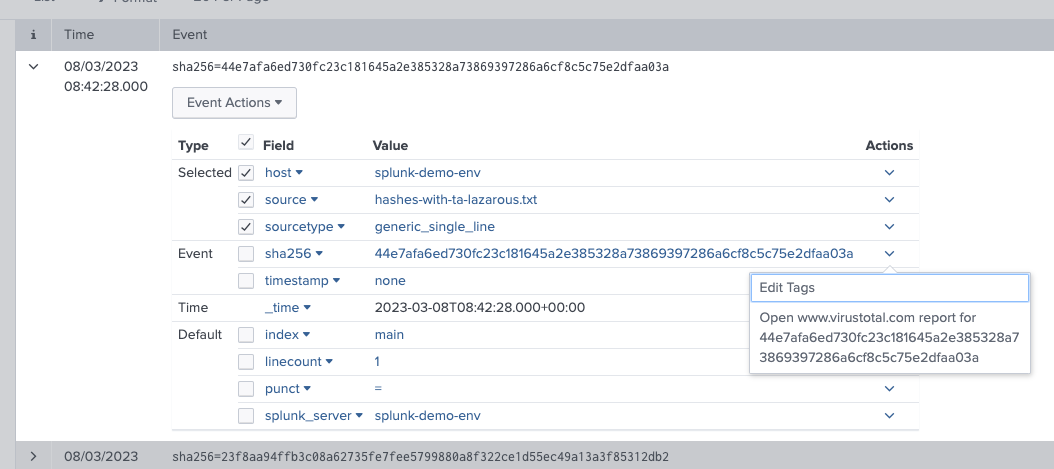
VT4Splunk incorporates hooks throughout the Splunk interface to open up full-blown VirusTotal reports:

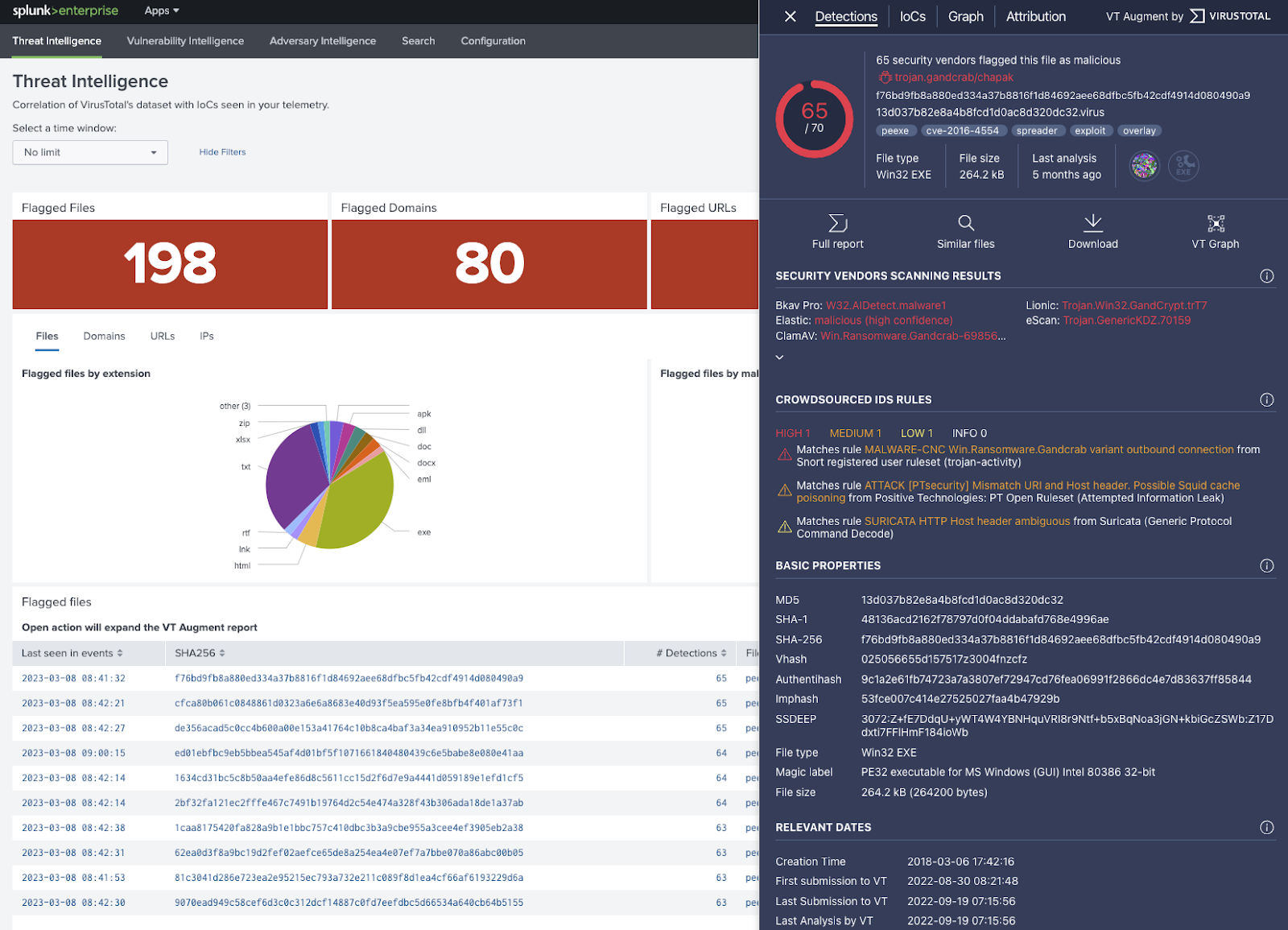
But most importantly, it also introduces triggers to open up the VT AUGMENT widget within Splunk, in a single pane of glass fashion, for all IoCs that get highlighted in dashboards and reporting views:

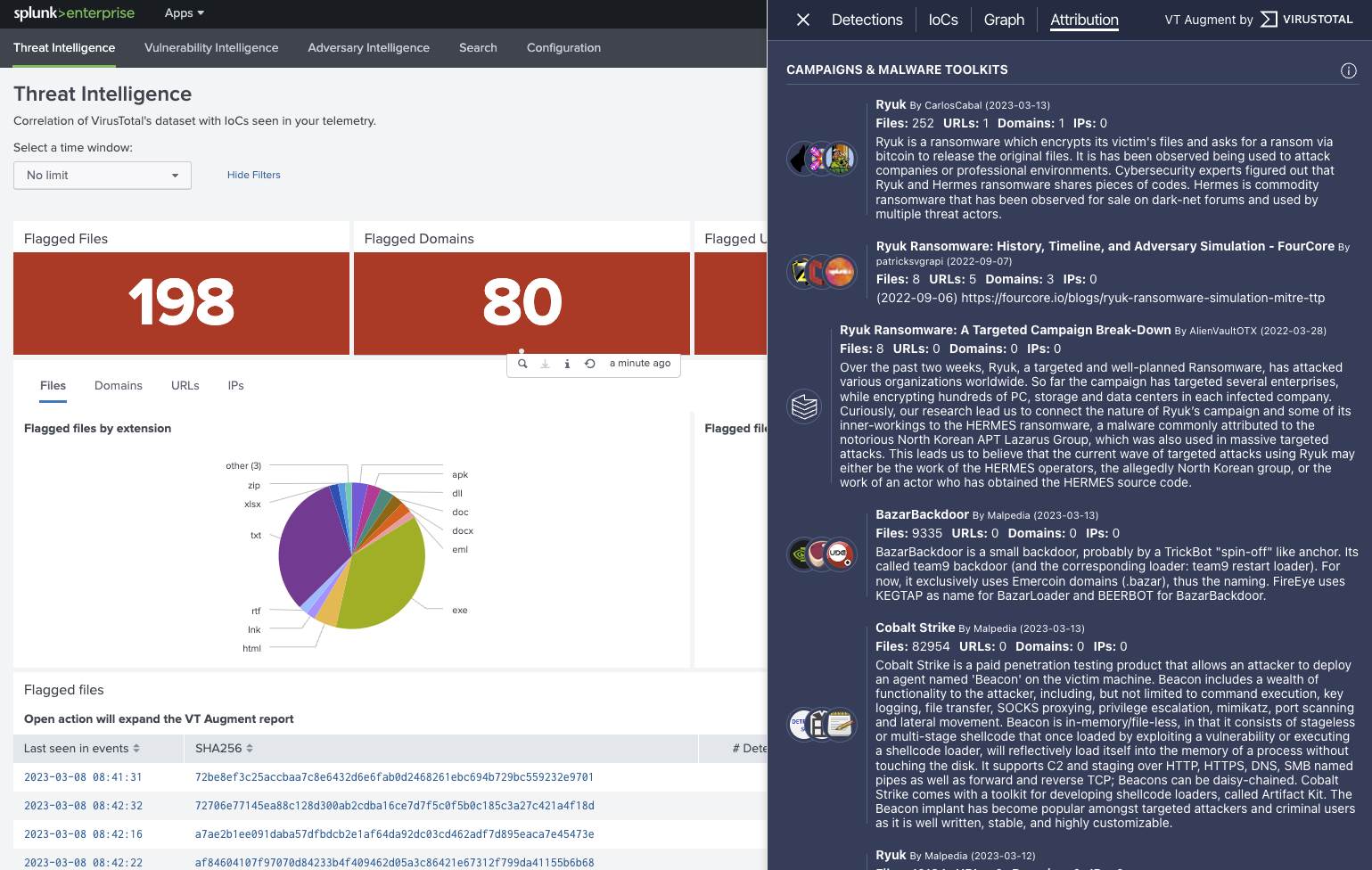
These Crowdsourced Intelligence cards do not only provide a detection 2nd opinion but also in-depth static, dynamic, code and threat graph analysis allowing analysts to make faster and more accurate decisions. Moreover, when available, the embedded report will add a layer of attribution describing campaigns, malware toolkits and threat actors tied to a given flagged IoC. 

Automatically prioritize threats with enrichment and triage via scheduled queries

The aforementioned command-line driven enrichment can actually be automated in the plugin’s configuration (Correlation Settings). 

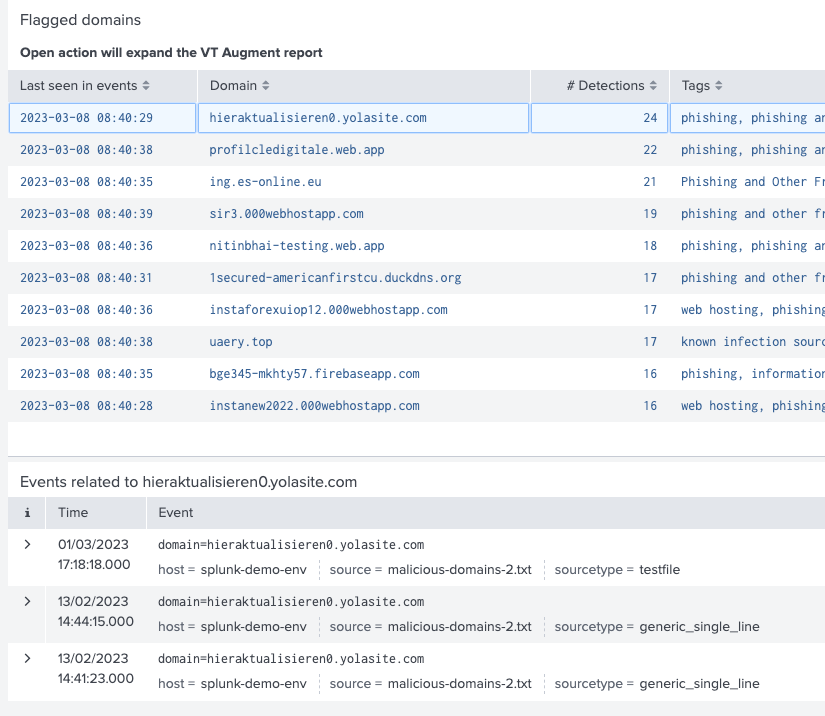
Upon doing so, any notable findings (flagged files, domains, IPs or URLs) will be called out in the Threat Intelligence view, which is both a dashboard and reporting vehicle summarizing malicious activity seen in your environment:

The flagged IoCs are contextualized with relevant data points such as the threat family or category, and upon clicking on them a table opens up with all events in which the pertinent IoC was seen, which tremendously expedites investigations.

Reduce exploitation risk by prioritizing patch application

The Vulnerability Intelligence view is also populated with correlations coming from automatic enrichment. It allows SOC teams to implement vulnerability prioritization. Some logs that are dumped into Splunk come from email gateways, firewalls and other solutions that have network perimeter visibility. These logs are a good reflection of what an organization’s threat landscape is, even when a security solution has stopped a threat, fully tailored intelligence can be derived from them.

Files submitted to VirusTotal are tagged with any CVEs for vulnerabilities that they might be exploiting. This means that VirusTotal allows you to understand which vulnerabilities are truly being abused in-the-wild by attackers as opposed to those for which there is only proof of concepts. 

Security teams often prioritize vulnerabilities based on their severity as reflected in the generic vulnerability report. This is suboptimal, it fully ignores whether the vulnerability is being actively exploited and whether you are actually being hit by exploits targeting it. 

VT4Splunk runs through all your events, extracts hashes seen in them, identifies those that are tagged in VirusTotal with CVEs and summarizes the findings in the Vulnerability Intelligence view. This allows you to implement a tailored vulnerability management strategy that represents the intersection of your organization’s threat landscape and in-the-wild exploitation. 


Again, clicking on any of the highlighted CVEs will open up a table listing all those files seen in your environment and abusing the pertinent vulnerability, and all those events in which those hashes were seen.

Identify threats dwelling undetected in your environment with Adversary Intelligence

VirusTotal is the richest and most actionable Crowdsourced Threat Intelligence suite, as such, its firehose of threats and sightings is often overwhelming. Security teams need to focus on what’s truly relevant for them and often prioritize incident response and threat handling based on the threat actors behind them.

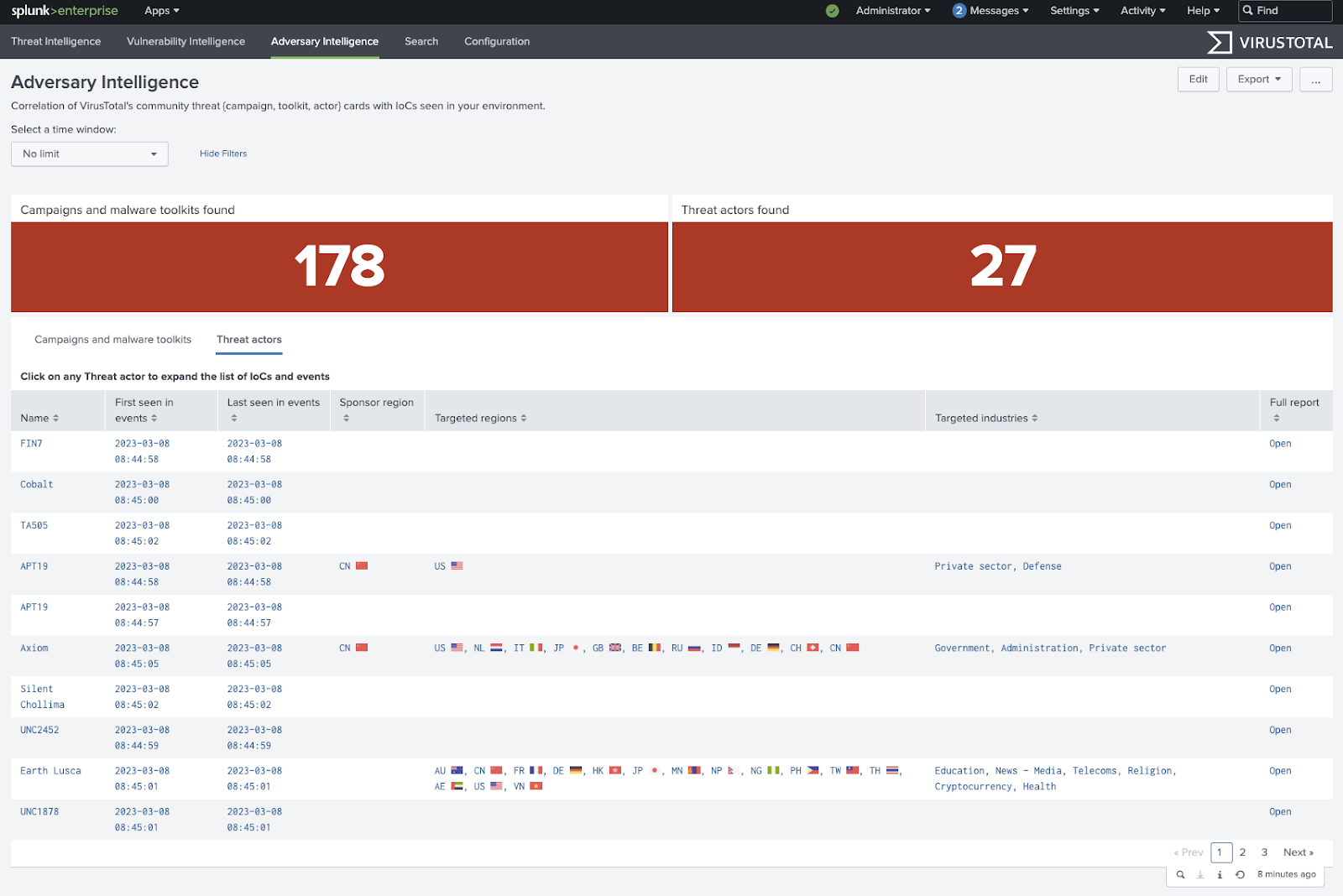
We recently rolled out threat {campaign, toolkit, actor} cards in VT ENTERPRISE. These reports summarize threat campaigns/actors, their motivations, targeted industries, source regions, etc. They also provide actionable intelligence such as related IoCs, TTPs, in-the-wild geo+time activity telemetry, {YARA, Sigma, IDS} rules to detect them, online reporting, etc.

If your account has access to the aforementioned Threat Landscape module, VT4Splunk will also populate an “Adversary Intelligence” view flagging any campaigns/toolkit or actors seen in your environment:

Yet again, upon clicking on an identified campaign/toolkit or actor, the associated IoCs and events in which they are contained will open up. This allows security teams to focus on more severe threats first as opposed to script kiddies, mass malware or generic ecrime. 

Similarly, all of the flagged items have a shortcut to jump into VirusTotal’s report about the given campaign/toolkit/actor, where you can continue to investigate and dive into things such as their geographical and time-based activity:

What’s coming next?

This is by no means the end of the road for VT4Splunk, we have many features in the making. Over the coming months, among other things, we will:

  • Add a MITRE ATT&CK view summarizing TTPs seen in your environment, through the dynamic analysis to MITRE ATT&CK mappings that VirusTotal sandboxes perform.

  • Incorporate a tab summarizing adversary TTPs into the Adversary Intelligence view, providing a more focused understanding of the modus operandi of identified actors in particular. 

  • Democratize threat hunting with one-click canned hunts that will act on the correlation of your events with VirusTotal analysis metadata and relationships.

  • Enhance detection with tailored threat feeds based on subscriptions to specific threat campaign/toolkit/actor cards, Livehunts and scheduled VT Intelligence queries. 

  • Implement multi-layered detection by allowing users to apply crowdsourced Sigma rules from VirusTotal to their own telemetry, acting as event based/behavioral pattern detection and thus complementing the rest of their security stack. 

Please do not hesitate to join us next March 30th, when we will host along with Splunk a webinar to show how to do security investigations with Splunk and VirusTotal. Register here!

Happy hunting!