Friday, May 12, 2023

VT Code Insight: Updates and Q&A on Purpose, Challenges, and Evolution

Following the announcement of VirusTotal Code Insight at the RSA Conference 2023, we've been thrilled by the overwhelmingly positive response from the cybersecurity community. As enthusiasm grows, we've been flooded with inquiries from those keen to discover more about Code Insight. To address these questions, we've put together a Q&A covering popular topics, including news about the tool's expanded capabilities. Our aim is to establish realistic expectations and provide a comprehensive understanding of Code Insight's purpose, challenges, and ongoing progress.

In case you missed our presentation at RSA, we compiled a brief video showcasing a few use cases:

What's New?

  • Code Insight has broadened its support for script formats, moving beyond PowerShell to offer analysis for a variety of scripting languages. Here are some examples:
  • The maximum file size limit for files processed by Code Insight has been doubled, allowing for analysis of larger files.
  • The model delivers more concise and focused high-level explanations, placing greater emphasis on code behavior.
  • The user interface has been redesigned to display only the first sentences of the report by default, with the option for users to expand the report as needed, preventing extensive reports from overwhelming the default view.

Q: Is Code Insight replacing current detection technologies?
A: No, Code Insight is no substitute for current detection technologies. Rather, it's an additional layer of support designed to boost performance of security analysts, offer a different perspective on the technical details and help the cybersecurity industry improve their technologies.

Q: Is Code Insight replacing human analysts in cybersecurity roles?
A: No, Code Insight is not designed to replace human analysts in cybersecurity. Instead, it serves as a powerful assistant and partner, enhancing their performance and effectiveness. The major advantage of Code Insight is its scalability, as it can act as an extremely productive junior analyst, working 24x7 and analyzing a vast number of files. This enables human analysts to receive preliminary analyses to help in their evaluation and focus on the most interesting or challenging samples. Ultimately, Code Insight's goal is to augment human expertise, rather than replace it, and to help the cybersecurity industry evolve by improving both technologies and workflows.

Q: Why is there a limitation on the size of PowerShell files analyzed with Code Insight?
A: The limitation on the size of PowerShell files analyzed with Code Insight stems from the inherent constraints of large language models (LLMs) concerning token inputs. LLMs have a maximum token limit for each input, which affects the amount of code that can be processed in a single pass.

Like we mentioned earlier in this blog post, Code Insight can now handle files twice the size it could before, and we're not stopping there. We're going to keep working on improving this aspect in the coming months. To overcome the limitations and increase the size of the analyzed code, we are developing several strategies. One approach involves breaking down larger code snippets into smaller chunks, processing them separately, and then combining the results. Another strategy focuses on refining the LLM's pre-processing and tokenization methods to optimize the handling of larger input sizes more efficiently.

Q: Can Code Insight analyze executables?
A: While Code Insight currently focuses on analyzing scripting languages, we are actively working on expanding its capabilities to handle executables and other file formats. Our approach comprises multiple stages, such as disassembling and decompiling, which enable the large language model to effectively generate natural language summaries of the analyzed code.

Q: What are some other limitations of Code Insight and improvements planned in the roadmap?
A: Code Insight is continuously learning and improving its accuracy based on experience and user feedback. One of the current limitations is it only uses code as its unique input, without any additional context about the cases being analyzed. Sometimes, it can be challenging to determine if something is legitimate or malicious based solely on the code. For example, a code snippet that downloads a remote file and executes it could either be a legitimate installer or a malware downloader. This lack of context can sometimes lead to model hallucinations, where the model may make incorrect assumptions about the code’s intent.

To address this limitation, we have plans in our roadmap to provide more context to Code Insight, ultimately improving its criteria and deep analysis capabilities. This includes giving access to any metadata related to the URLs and files linked in the code snippet. By incorporating additional context, Code Insight will be better equipped to distinguish between legitimate and malicious behavior, enhancing its overall effectiveness.

Q: Can attackers develop strategies to confuse Code Insight and provoke mistakes in its judgment?
A: Yes, it was anticipated, and indeed, it has been happening from the very moment Code Insight was announced. As we highlighted in our prior blog post, it's crucial to acknowledge that attackers can devise strategies to deliberately confuse LLMs when analyzing code and cause them to make errors in judgment. This is similar to how they continually refine their tactics to bypass or mislead traditional detection technologies such as antivirus, EDRs, sandboxing, IDS/IPS, and so on.

Q: Have you detected any active malware specifically crafted to confuse Code Insight?

A: So far, we haven't detected any malware designed to confuse Code Insight that has been used in real attacks. However, we have observed numerous proof-of-concept attempts testing prompt injections and other tricks during the first few days after the announcement, as expected. We remain vigilant and anticipate more genuine attempts in the future if attackers and malware creators start to recognize the effectiveness of Code Insight in enhancing cybersecurity measures.

Q: Do you plan to filter out crafted samples designed to confuse Code Insight?

A: No, the nature of VirusTotal is to scan everything, including malware with advanced obfuscation or any kind of attack technique aimed at bypassing detection capabilities. Our mission is to provide our partners and security teams with access to any observed threat to learn and improve product performance and overall security posture. Embracing failure and learning from mistakes is a crucial part of the journey to improve and evolve Code Insight. It continuously learns from attackers' attempts to confuse its judgment, adapting and enhancing its capabilities to remain a valuable tool for security analysts. By analyzing a wide range of samples, including those crafted to cause confusion, Code Insight gains valuable insights that contribute to its ongoing development and effectiveness.

Q: How can I help improve Code Insight?

A: Your feedback is critical to learning and evolving Code Insight. The community's input helps us identify areas for improvement and fine-tune the system for better performance. You can contribute by providing feedback through the "Thumbs Up" and "Thumbs Down" buttons, which you can find in the bottom right corner of the Code Insight reports. These buttons let you express positive or negative feedback on the analysis results. By sharing your insights, you play a valuable role in enhancing the capabilities of Code Insight and driving its ongoing development.
Screenshot

Q: How does Code Insight integrate with VirusTotal Intelligence?

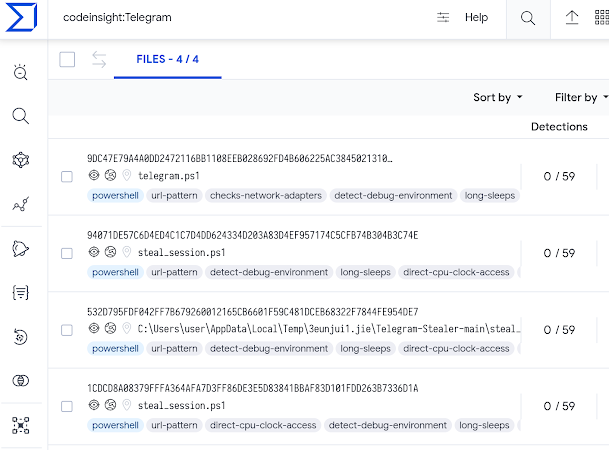
A: Code Insight's true value lies in its ability to scale analysis through the VirusTotal platform, allowing for the examination of individual code samples and the aggregation and exploitation of results on a large scale via VirusTotal Intelligence. All results generated by Code Insight are already easily searchable, pivotable, and accessible through API calls. This enables security teams to quickly and effectively scrutinize vast quantities of code and identify potential threats, ultimately enhancing their security stance.

Example of VTI query with Code Insight include to search samples related to Telegram:
Screenshot 2023-05-05 10.52.55

Q: Are there any additional functionalities of Code Insight specifically for VirusTotal Intelligence users?

A: Yes, one of the key features in our roadmap is the introduction of Code Insight on demand for VT Intelligence users. This functionality allows VT Intelligence users to copy and paste code snippets for immediate analysis by Code Insight, bypassing the need to submit entire samples to VirusTotal. This on-demand feature emphasizes a crucial distinction compared to the standard Code Insight process, where submitted samples may or may not be processed by Code Insight depending on pre-filtering criteria.

The pre-filtering criteria take into account several factors such as size, similarity with previous code snippets already processed by Code Insight, abuse signals, and other relevant considerations. This filtering mechanism ensures that Code Insight focuses on the most valuable and unique samples, which helps maintain the platform's overall efficiency and effectiveness.

However, with the on-demand functionality tailored for VT Intelligence users, security professionals can ensure that their specific code snippets are directly analyzed by Code Insight. This provides a more streamlined and targeted approach, enabling users to receive quick and precise results to further enhance their security posture.

Q: I have new ideas and use cases for implementing AI in VT, and I'm interested in contributing with new models and tools. Can I do this?

A: Absolutely! VirusTotal thrives on its community-driven approach, welcoming contributions from users and companies who have innovative ideas for enhancing the platform. We are eager to consider new features and integrate tools from contributors who share our passion for improving cybersecurity for the benefit of the global community. If you have any new ideas, suggestions, or tools, please don't hesitate to reach out to us. Your expertise and creativity can make a significant impact in advancing our collective efforts in the cybersecurity field, ultimately promoting a safer digital environment worldwide.

What's Next for Code Insight?

We are in the early stages of Code Insight's development; this is just the beginning. We continue to enhance and expand the current features while exploring new avenues to assist analysts even more effectively. Our plans include:

  • Further expanding file type and size support.
  • Analyzing binary and executable files.
  • Enriching analysis with contextual information besides the code itself.

Your feedback and support play a vital role in helping us stay ahead of evolving cyber threats. Thank you for your continued involvement, and stay tuned for more updates and developments from VirusTotal.

Happy hunting!

Thursday, May 04, 2023

Actionable Threat Intel (I) - Crowdsourced YARA Hub

 YARA rules are an essential tool for detecting and classifying malware, and they are one of VirusTotal’s cornerstones. Other than using your own rules for Livehunts and Retrohunts, in VirusTotal we import a number of selected crowdsourced rules provided by contributors to help identify and classify samples (example report). However, finding, tracking and managing VirusTotal’s crowdsourced YARA rules can be challenging, especially as the number of rules and contributors grow. To address this, we introduce the new VirusTotal’s Crowdsourced YARA Hub, allowing users to easily search and filter existing rules, track new ones and one-click export any of them to Livehunt and Retrohunt.

It is important to highlight that the Crowdsourced YARA hub does NOT include your private VirusTotal Livehunt/Retrohunt rulesets, it rather centralizes all contributor/community YARA rules that are currently contextualizing files submitted to VirusTotal. 

The new Crowdsourced YARA Hub can be found under “Livehunt”.


The new repository makes it easy to find existing YARA rules. Users can filter rules based on different criteria such as when the rules were created, who authored them, number of matches and threat category (based on the top threat categories in the samples matching the rule), in addition to search rules by name, description or metadata. This helps users quickly find the rules they need and avoid duplicating efforts. For example, let’s find all rules whose description, fields or title contain the word ransomware:

https://www.virustotal.com/gui/crowdsourced-yara-hub?filter=%22ransomware%22 

This makes it way easier for VirusTotal’s users monitoring new rules for particular actors or campaigns, checking if any rule of our interest gets updated and being on top of fresh rules. Additionally, visualizing the number of matches also helps understanding the prevalence of given rules and calibrating its impact when we find matching samples during our investigations. 

Moreover, it is also a vehicle to stay up-to-date with emerging threats identified by the community. 

Additionally, the new central repository allows users to check and import YARA rules into other pipelines easily. You can visualize, copy, download and one-click import rules into Livehunt and Retrohunt. Downloading and exporting allows you to action the rule against your environment via your EDR or forensics tools with YARA support. As usual, you can check all matches for a given rule.


Did you notice how gorgeous YARA rules look in our new YARA editor? This is just a sneak peek of a very basic version and we will be providing more details very soon, but get ready for a YARA editor on steroids!


Conclusion


The new Crowdsourced YARA Hub provides many advantages that will help all VirusTotal’s users get familiar with and leverage crowdsourced YARA rules. Now it should be way easier finding rules of our interest, filtering out noisy rules from our analysis and focusing on the interesting ones and understanding what new rules are available to us to track actors and campaigns, all in a new interface that makes it easier to visualize them and one-click import rules into any pipeline. We encourage all our users to give it a try and share with us any feedback, and all YARA rules creators to let us know if you are interested in sharing your amazing rules with the VirusTotal community.


Happy hunting!


Monday, April 24, 2023

Introducing VirusTotal Code Insight: Empowering threat analysis with generative AI

At the RSA Conference 2023 today, we are excited to unveil VirusTotal Code Insight, a cutting-edge feature that leverages artificial intelligence for code analysis. Powered by Google Cloud Security AI Workbench, Code Insight produces natural language summaries of code snippets with ease. This functionality empowers security experts and analysts by providing them with deeper insights into the purpose and operation of analyzed code, significantly enhancing their capability to detect and mitigate potential threats.

For quite some time, artificial intelligence (AI) and machine learning (ML) have played a crucial role in anti-malware and cybersecurity, mainly focusing on classification tasks. However, recent advancements in large language models (LLMs) have expanded their capabilities to encompass text generation and summarization. 

Impressively, when these models are trained on programming languages, they can adeptly transform code into natural language explanations. This innovation not only expedites malware analysis but also bolsters a variety of cybersecurity applications. Recognizing the immense potential of this cutting-edge technology, we have incorporated it into the VirusTotal platform, significantly enhancing its capabilities.

Code Insight is a new feature based on Sec-PaLM, one of the generative AI models hosted on Google Cloud AI. What sets this functionality apart is its ability to generate natural language summaries from the point of view of an AI collaborator specialized in cybersecurity and malware. This provides security professionals and analysts with a powerful tool to figure out what the code is up to. 

At present, this new functionality is deployed to analyze a subset of PowerShell files uploaded to VirusTotal. The system excludes files that are highly similar to those previously processed, as well as files that are excessively large. This approach allows for the efficient use of analysis resources, ensuring that only the most relevant files (such as PS1 files) are subjected to scrutiny. In the coming days, additional file formats will be added to the list of supported files, broadening the scope of this functionality even further.

Let's examine a few examples derived from authentic situations to truly appreciate the functionality of this feature. 

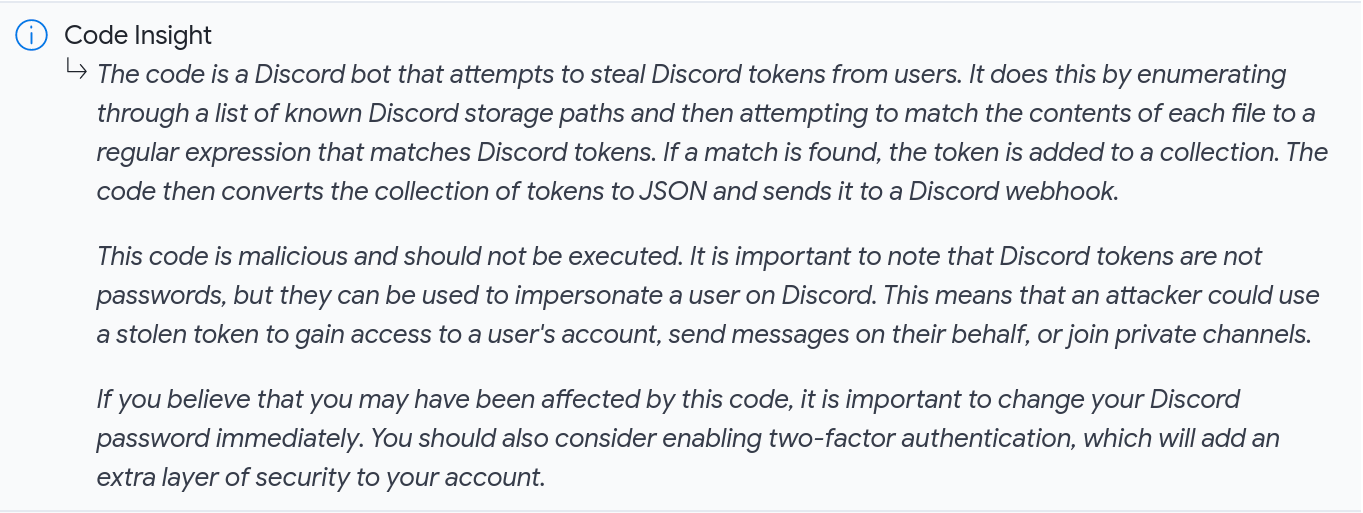
In this first case, we have a file that was detected by only three engines on VirusTotal as “PowerShell/PSW-Agent.U” and “HEUR.Trojan-PSW.Multi.Disco.gen”. Meanwhile, Code Insight provided the following explanation:


https://www.virustotal.com/gui/file/74662107227a6a28bebb77d5b9ec3890a80e507ee22ed99eb17f35c9d8730bf3/detection

Unveiling false negatives


It's important to note that Code Insight conducts its analysis independently, relying solely on the content of the file being processed, without access to antivirus results or any other associated metadata. A good example can be observed in this case of a false negative, where Code Insight’s explanation helps us detect malware to stealth user’s credentials that has not been identified by any antivirus software in VirusTotal:


https://www.virustotal.com/gui/file/552efb0dc7e62ded08c98d2e6355df1d27a1317c0a37aabeefd48667b7b1917b/detection

Clearing false positives


In this other example, we have a file that is flagged as trojan and malware by 9 antivirus engines, but it's actually a false positive. Here we can see once again how Code Insight can be a valuable ally when managing incidents and analyzing potential malware. In this case, it explains that it's simply a script that installs Postman CLI:


https://www.virustotal.com/gui/file/b5796d7e4a9efc0b81efdc94b3e42ba6a6ef71d10274e3b812cd5ef4dfb8787b/detection

In this last example, Code Insight demonstrates how it can help improve file categorization in VirusTotal. Code Insight accurately identifies the sample’s file type and fixes the tag that misclassified it as JavaScript.

Although the selected examples illustrate accurate descriptions, the performance of the LLM model may vary on a case-by-case basis, including judgment errors. It’s highly likely that attackers develop new evasive strategies and an ongoing competition between malware and this new approach is expected. That’s why it is crucial for a security analyst to oversee these features as they ultimately need to interpret this information combined with other contextual information and correlations relevant to the case at hand.

Nevertheless, the integration of LLMs into the arsenal of code analysis tools is a significant advancement that enables security professionals to gain valuable insights into the structure and behavior of potentially malicious code, improving threat detection and response efficiency.

Code Insight in VirusTotal Intelligence


This kind of analysis can be carried out by various AI models, each offering varying levels of precision and depth. However, the true value of VirusTotal's Code Insight lies in its capacity to scale this analysis through its platform. This enables not only the examination of individual code samples, but also the aggregation and exploitation of results on a large scale via the VirusTotal Intelligence service. As a result, security teams can swiftly and effectively scrutinize vast quantities of code and identify potential threats, enhancing their efficiency and ultimately fortifying their security stance.

Here’s an example of searching for ”codeinsight:keylogger”:


VirusTotal Intelligence finds several files that, according to the Code Insight report, record keystrokes and write them to a log file. Let’s expand the report of the first one, then we can read a comprehensive analysis explaining this specific keylogger’s behavior:


https://www.virustotal.com/gui/file/d6111869a8088e2d1b49a92a30fc3d477373d88a4a2f1a7da4e75ce85dc08ba4/detection

As we continue to refine and expand the capabilities of VirusTotal Code Insight and other cutting-edge features, we remain dedicated to providing our community with the most advanced and effective tools to stay ahead of evolving cyber threats. We are truly excited about what the future holds and are eager to continue pushing the boundaries of what is possible in the field of cybersecurity. Stay tuned for more updates and developments from the VirusTotal team.

Thursday, April 20, 2023

APT43: An investigation into the North Korean group’s cybercrime operations

Introduction 

As recently reported by our Mandiant's colleagues, APT43 is a threat actor believed to be associated with North Korea. APT43’s main targets include governmental institutions, research groups, think tanks, business services, and the manufacturing sector, with most victims located in the United States and South Korea. The group uses a variety of techniques and tools to conduct espionage, sabotage, and theft operations, including spear phishing and credential harvesting.

From VirusTotal we wanted to contribute to a better understanding of this actor’s latest activity based on their malware toolset’s telemetry, including geographical distribution, lookups, submissions, file types, detection ratios, and efficacy of crowdsourced YARA rules for the IOCs attributed by Mandiant to this threat actor. All the data provided in this post is also available for VirusTotal users through VT Intelligence. It can be obtained by aggregating Telemetry and Commonalities from a set of IOCs, which you can do using a VT Intelligence search, Collection or Graph. 

Malware artifacts

File type distribution

We used Indicators of Compromise (IOCs) attributed to APT43 by Mandiant to collect telemetry on the threat actor’s latest activity, resulting in the following file type distribution: 


Microsoft Word documents (docx) are the most common file format among the samples we analyzed. This suggests that APT43 relies heavily on Microsoft Word documents as a vector for delivering malicious payloads or exploiting vulnerabilities. We also found that most of these files used macros as their infection technique, while only a few of them exploited the CVE-2017-0199 vulnerability, which allows attackers to run malicious code on target systems by embedding malicious links in the docx file. 

The file type distribution also reveals interesting patterns. For example, we can see that there are more pedll files than peexe files, even though both are executable formats. Further analysis of the pedll files revealed that the majority of them used the T1129 MITRE ATT&CK technique, which involves executing malicious payloads via loading shared modules. Another example is that there are more hwp files than doc files, even though both are word processing formats. This may indicate that APT43 targets specific regions or organizations that use Hangul Word Processor (HWP), a popular software in South Korea.

Lookups and submissions timeline

The oldest of the samples we analyzed, a portable executable, was uploaded in July 2018 from the United Kingdom.  

The initial submission triggered only five positive detections, but after subsequent submissions from South Korea and Italy, the latest one being on March 30, there are now more than 40 detections. This is an important remark on how typical AV detections evolve protection as new techniques and artifacts are discovered.   


For user queries (lookups) now associated with APT43, which speak of the interest of VirusTotal’s users on particular samples, there was a peak around April 2021, maybe related to some particular APT43 campaign. The plateau starting July 2022 might be related to security companies monitoring this actor’s activity. The very recent peak in April 2023 is most likely related to the publication of APT43, which revamped the interest from security analysts on this actor and related artifacts. 


From January to April this year, most of the submissions came from South Korea, and the file type most associated with these submissions was the docx file. For lookups, most of them are from the United States with apk files being the most looked up, followed by docx, text, html, powershell, and peexe.


Geographical distribution

File sample submissions and lookups are important indicators of cyber threat activity and awareness. By analyzing the geographical distribution of these activities, we can gain insights into the regions that are most affected by or interested in a particular threat actor or campaign.

According to our telemetry data, the top countries for file sample submission are South Korea, the United States, Italy, Israel, and the United Kingdom.

South Korea stands out as the country with the most file sample submissions, accounting for almost half of the total submissions. This is not surprising, given that South Korea is (probably) the primary target of APT43, as pointed out by Mandiant. Submissions of the identified samples are observed from July 2018 to April 2023. 


On the other hand, South Korea ranks third in file sample lookups which is consistent with their leading position in file sample submissions. This is remarkable given South Korea’s number of VT submitters, well below top 10 countries.

Interestingly, Turkey stands out as the country with the second highest number of lookups, even if they are not among top submitters. This may suggest that Turkey is either a victim or a conduit of North Korean cyber attacks. Lookups of the identified samples are observed from October 2020 to April 2023.


Detections

Analysis from the commonalities tool reveals the most common threat categories as trojan, downloader and dropper. Of the identified samples, 32% of the samples with threat names assigned to them are labeled ‘kimsuky’. Mandiant’s report mentions kimsuky as being used by multiple companies in their public statements on APT43’s activities.

To get a sense of the detection distribution among the samples we analyzed, we divided them into four categories: 

  • 15 or more detections, 

  • less than 5 detections, 

  • between 10 and 15 detections, and 

  • between 5 and 10 detections. 

The most common category was for 15 or more detections, representing 83% of all samples. On the other hand, samples with less than 5 detections came in at 9.7%. The other two categories, between 5 and 10 detections and between 10 and 15 detections, came in at 2.4% and 4.8%, respectively.


MITRE ATT&CK

During our analysis of the samples using the commonalities tool, we observed several MITRE ATT&CK techniques adopted to APT43 to compromise and exfiltrate data from their targets. VirusTotal extracts TTPs from samples by detonating them in different sandboxes and using tools such as CAPA. Among the techniques, the most prevalent ones were:

  • T1082: System Information Discovery

  • T1083: File and Directory Discovery

  • T1129: Execution through Module Load

  • T1055: Process Injection

  • T1071: Application Layer Protocol

Crowdsourced YARA rules

Of all the samples analyzed, quite a few of them triggered some crowdsourced YARA rules. The YARA rule that detected quite a few of the samples was one created by InQuest Labs, Ruleset: Office_Document_with_VBA_Project. The rule was created to detect any Office document with a VBA project in them. While a VBA project within an Office document is used for automating tasks, it can also be used to perform a range of malicious actions such as stealing sensitive data, installing malware, and modifying or deleting data. It can even be used in phishing attacks where the emails contain attachments with malicious VBA macros. In Mandiant’s publication, they point out APT43’s use of SPICYTUNA, which is a VBA downloader. This rule could be used as a soft signal.

Another crowdsourced YARA rule that detected a few of the analyzed samples was one by Florian Roth, which detects the Ghost419 RAT used by the Gold Dragon malware: GoldDragon_Ghost419_RAT. Mandiant reports that the malware extracts a payload from a hwp document and writes it to a startup directory resulting in the new file being executed when the current user logs in.

A sample using the Gh0st RAT malware was detected by one of the crowdsourced rules: GhostDragon_Gh0stRAT. The malware is a backdoor written in C++ that communicates via a custom binary protocol over TCP or UDP, as reported by Mandiant.

Collections

Collections are how our users can group different indicators in a shareable set. This has great benefits, such as providing a name and description, external references, attribution, etc. In addition it helps working with large datasets and obtaining commonalities, telemetry and other aggregated data. Other than this, we daily create dozens of collections based on OSINT security incidents and publications.


During our analysis of the samples, we observed that several of them belonged to two different collections created by AlienVaultOTX: APT43: North Korean Group Uses Cybercrime to Fund Espionage Operations and Analysis of Smoke Screen in APT campaign aimed at Korea and America. For the first collection, we observed that it contained a variety of file types such as pedll, peexe, docx, php, and powershell in that order. The second collection was different, however, as it contained only two file types. We found that the majority of the files were docx files which accounted for over 90% of the samples, and the remaining were peexe files.


Conclusions

This blog post sheds light on the activities of APT43, a threat actor operating on behalf of the North Korean regime. We have used VirusTotal’s features to explore the file type and geographical distributions, detections, ATT&CK techniques, collections, and crowdsourced YARA rules related to the threat actor’s campaign. We hope that this post has provided some insights into the capabilities and techniques of APT43, and how VirusTotal can help to monitor and investigate such campaigns. 

We hope you found this useful, and please reach out to us if you have any suggestions or just want to share feedback.

Happy hunting!


Monday, April 03, 2023

VirusTotal += Deep Instinct

 We welcome Deep Instinct to VirusTotal. In their own words:

"Deep Instinct is the only prevention-first cybersecurity company with a natively architected deep learning platform. We keep enterprises safe by stopping >99% of threats before other solutions even see them – at a speed and scale, unprecedented in the industry. Deep Instinct significantly reduces detection noise and false alert storms to reduce overall risk, improve SOC team productivity, and improve the total cost of ownership of our customers' entire cybersecurity stack. For more, visit www.deepinstinct.com.”


Deep Instinct has expressed its commitment to follow the recommendations of AMTSO and, in compliance with our policy, facilitates this review by AV-Comparatives, an AMTSO-member tester.